The art of keeping: exhibit features artist Betye Saar at 100
By Chela Simón-Trench
Betye Saar would have turned 100 years old on July 30. Saar was a legendary native Angeleno artist and central figure of the West Coast Black Arts movement. She pioneered assemblage art, a practice that combines found objects into sculptural compositions that reframe their original contexts and meanings.
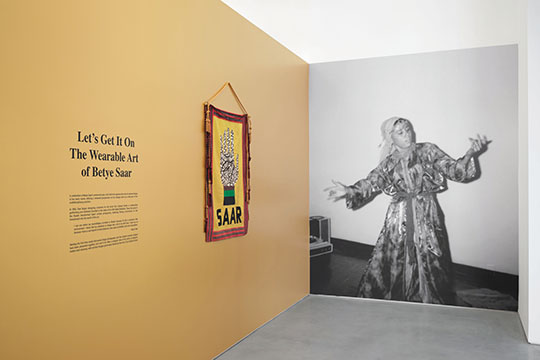
INSTALLATION VIEWS of “Let’s Get It On: The Wearable Art of Betye Saar” at Roberts Projects.
On the occasion of her milestone birthday, Roberts Projects, an art gallery that has long represented and championed Saar’s work, opened the exhibit “Let’s Get It On: The Wearable Art of Betye Saar.” The exhibition culminates a decade-long effort by the gallery and Saar’s studio to catalogue her extensive archive. Drawing from those materials, it explores the 1950s through the 1970s, revealing lesser-known designs, artworks, and sides of the inimitable Betye Saar.
“Let’s Get It On: The Wearable Art of Betye Saar” is on view at Roberts Projects through Sat., Aug. 22. Saar is best known for using assemblage to imagine new, empowering realities for racist memorabilia. Her most famous work, “The Liberation of Aunt Jemima” (1972), reimagines the familiar mammy figure as a warrior, armed with a gun and a grenade against a backdrop of Aunt Jemima portraits.
Throughout her career, Saar has created assemblages that imagine new realities for everyday objects, often contained within shadow boxes and even Altoids-sized tins. Being with one is like peering into an incredible, revolutionary dollhouse world filled with joy, history, reclaimed power, feminist spirit, and a strength of character that is unmistakably Saar’s.
The two main galleries of “Let’s Get It On” feature notebook sketches and enlarged vinyl photographs of Saar’s costume designs. My favorite part of the exhibition, however, was in the two smaller galleries at the end. Glass display cases hold family photographs, miniature assemblages, tapestries, belts, bibs, album covers, and greeting cards, all designed by Saar. Not everything was particularly wearable, but together they formed the fabric of her life in the 1950s-70s.
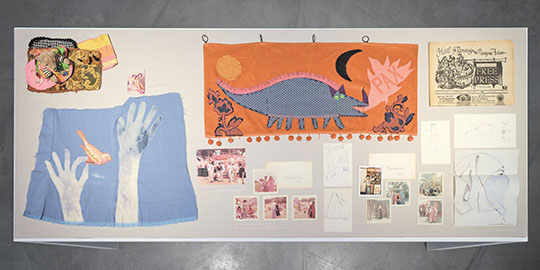
DRAWINGS, COSTUMES from the Renaissance Pleasure Faire.
Photos courtesy of the artist and Roberts Projects, Los Angeles.
Saar’s practice has always depended on collecting, preserving, and cataloguing. Before an object can be transformed into an assemblage artwork, it first must be kept. That made the display cases feel especially fitting for this archival exhibition, almost like assemblages themselves. Peering into them evoked the very feeling of a Saar assemblage: nostalgia and beautiful reinvention.
Objects with past lives sit alongside photographs of Saar’s own past life—from the Renaissance Pleasure Faire, costumes she made, a mini dress sewn for her daughters, a tiny assemblage of dog figurines dancing on the moon, and a birthday card bearing the cheeky message, “Sinner or saint (young is one of the things you ain’t), Happy Birthday DAH-ling.”
It is another side of the feminist, political artist extraordinaire that is Betye Saar. Here, she is the lifelong Los Angeles resident, undying collaborator, and mother, full of play and sunshine. It is a truly joyful window into the endless range of Saar’s artistic practice. As the archives continue to be catalogued and as Saar herself continues making art at 100, I hope for more exhibitions like this one.
The gallery is located at 442 S. La Brea Ave. Admission is free. Open Tuesday to Saturday, 11 a.m. to 6 p.m.
Editor’s Note: Betye Saar passed away July 26, days prior to her 100th birthday.
Chela Simón-Trench is a Windsor Square native who works in Los Angeles’ art world and writes about the artists and exhibitions shaping the city.
Category: People