States move to stop Paramount-Warner Bros. merger
By Jon Vein
Just beyond the eastern edge of Hancock Park sits one of the last great working movie studios in Los Angeles. Now Paramount Pictures is at the center of an antitrust battle that could help determine the future of Hollywood.
California and 11 other states have sued to block Paramount Skydance’s proposed acquisition of Warner Bros. Discovery, a transaction the companies value at approximately $110 billion. The lawsuit argues that combining two of the remaining major Hollywood studios would reduce competition, potentially harming movie theaters, workers, and consumers.
The case presents a familiar antitrust concern in a media world that has become anything but familiar.
The states’ strongest argument is straightforward: Paramount and Warner Bros. are direct competitors. Both produce and distribute major theatrical films. Both commission movies and television programs. Both negotiate with theaters and distributors. Combining them necessarily eliminates one independent competitor.
According to the states’ complaint, the combined company would account for more than 27% of theatrical film distribution revenue. The states argue that this could give the company greater leverage in negotiations with movie theaters, allowing it to demand a larger share of ticket revenue or other favorable terms. Smaller and independent theaters could be particularly vulnerable.
The states also point to Disney’s 2019 acquisition of most of 21st Century Fox as a cautionary example. According to the complaint, Disney and Fox distributed a combined 112 wide-release films during the four years before the merger. From 2022 through 2025, the combined company distributed 54.
Those numbers are striking, but they do not by themselves prove that the merger caused a comparable decline in the total number of movies being made.
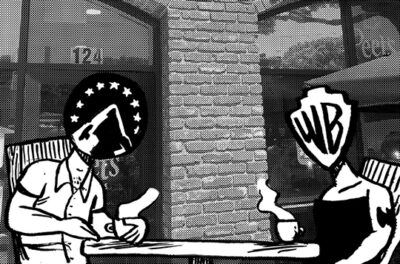
GETTING FAMILIAR with each other, the studios weigh their compatibility. Drawing by Finn Walker.
When Disney acquired Fox, Hollywood was entering an extraordinary production boom. Netflix was rapidly expanding its slate of original films and television shows. Amazon and Apple were spending billions to establish themselves as major entertainment companies. Other streaming services were entering the market, and traditional media companies were launching platforms of their own.
The disappearance of Fox as an independent studio therefore occurred at the same time that new buyers were flooding into the entertainment business. For a period, the streaming boom helped offset—and in some areas more than offset—the contraction of traditional Hollywood.
That boom has since substantially reversed. As investors shifted their focus from subscriber growth to profitability, streaming companies became more selective and reduced production. The contraction had begun before the 2023 writers’ and actors’ strikes, but the strikes became an inflection point after which production never returned to its previous levels. The era commonly known as “Peak TV” ended.
That makes the proposed Paramount-Warner merger different, at least in its timing, from Disney’s acquisition of Fox. If another major studio disappears as an independent buyer today, there may be no comparable wave of new production spending waiting to replace it.
This is one reason the antitrust case is more complicated than simply counting the number of Hollywood studios.
Antitrust law requires courts to determine the market in which competition may be reduced. If that market is defined narrowly as the distribution of wide-release theatrical films, Paramount and Warner Bros. are plainly significant competitors, and combining them creates a more concentrated industry.
But Paramount and Warner no longer compete only with the companies whose names appear on Hollywood studio gates.
Netflix, Amazon, and Apple have become major entertainment companies. YouTube reaches enormous global audiences. Younger consumers, in particular, spend increasing amounts of time with short-form, user-generated, and creator-driven content on social platforms. Movies and traditional television are competing for attention in an entertainment universe far larger than the one that existed when modern antitrust law was developed.
That does not necessarily mean that a YouTube video or a TikTok clip belongs in the same legal market as a theatrical motion picture. Antitrust law generally requires more than evidence that two products compete for a consumer’s finite leisure time. The question is whether consumers actually view them as substitutes.
The industry has therefore changed in two seemingly contradictory ways. For consumers, the number of entertainment choices has exploded. For companies and individuals trying to sell and produce professionally made movies and television programs, however, the extraordinary expansion of buyers during the streaming wars has retreated.
That creates a second potential competition issue. Paramount and Warner Bros. are not only sellers of entertainment; they are also buyers of scripts, projects, talent, and production services. Combining them would mean one fewer independent company deciding which movies and television programs to finance and produce.
For Los Angeles, that question has particular significance. Entertainment production supports not only actors, writers, directors, and producers, but also electricians, carpenters, drivers, costume designers, editors, caterers, equipment-rental businesses, and thousands of other workers—an ecosystem has already contracted sharply. According to FilmLA, television production in Greater Los Angeles fell from 18,560 on-location shoot days in 2021 to 7,716 in 2024, a decline of more than 58% in three years. Production fell again in 2025, although early 2026 has shown some encouraging signs.
The states’ argument is that further consolidation risks reducing competition at precisely the moment the industry is already producing less.
The counterargument is that scale may be necessary for traditional entertainment companies to survive and compete. A larger company could spread the enormous costs of streaming and technology across a broader business, compete more effectively for global audiences, and potentially have greater resources to invest in production. From that perspective, two weakened companies remaining independent may not necessarily produce more movies, more television, or more jobs than one financially stronger company.
The disagreement has already divided government regulators. The federal Justice Department investigated the transaction and closed its inquiry without challenging the merger. California and 11 other states have now reached a different conclusion and are asking a federal court to stop it. That disagreement reflects the difficulty of applying traditional antitrust principles to an industry undergoing rapid technological change.
The states can make a simple and powerful point: combining two major studios leaves one fewer major studio. Paramount can respond that counting studio gates no longer describes the market in which entertainment companies actually compete.
Both arguments have force.
For Los Angeles—and for neighborhoods surrounding Paramount’s historic studio lot—the outcome is more than an abstract debate over market concentration. It raises a larger question about whether Hollywood’s future depends on preserving more independent studios or allowing those studios to combine in order to compete in a media world that has fundamentally changed.
The court will have to decide whether this merger threatens competition. The harder question for Hollywood may be what meaningful competition looks like now.
Category: News