State Senate District 26 is up for grabs
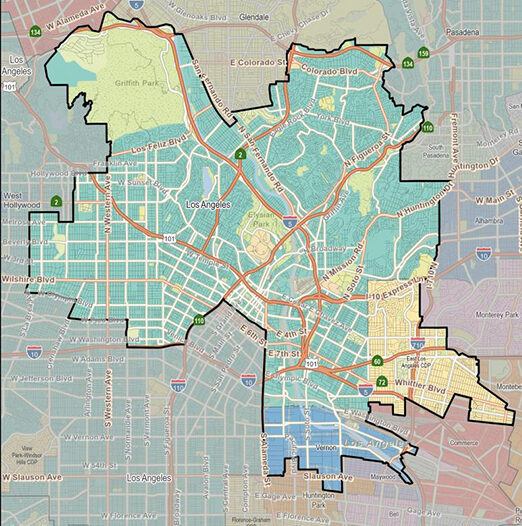
MAP OF STATE SENATE DISTRICT 26.
By Nona Sue Friedman
The seat for State Senator of District 26 is available and two candidates are looking to fill the spot: Sara Hernandez and Sarah Rascón. In this paper’s circulation area, District 26 encompasses Western Avenue to the east, La Brea Avenue to the west, Melrose Avenue to the north, and Olympic Boulevard to the south.
In California, a state senator represents a little under one million people. They are the district’s delegate, working in Sacramento in the upper house of the state legislature as a liaison for their constituents, proposing and writing laws, and helping to pass California’s annual budget.
With Senator María Elena Durazo deciding not to run for another term, her seat for District 26 was available. Two candidates, Sara Hernandez and Sarah Rascón, were the top winners in the primaries.
The Chronicle sent four questions to each candidate and have printed their answers here. Some modifications were made to accommodate for space.
Sara Hernandez
What are your thoughts on Los Angeles Municipal Code 41.18, which prohibits homeless encampments within 500 feet of schools, recreation centers, senior centers, libraries, and other sensitive use locations?
I support 41.18. We can have compassion for people experiencing homelessness while also keeping these public spaces safe and accessible.

SARA HERNANDEZ
As a mom and former teacher, I feel especially strongly about schools. Parents should know their children can safely walk to school, use a playground, or get to an after-school program. Seniors, families, and people with disabilities deserve that same sense of safety in the public spaces they rely on. The reality in Los Angeles is that the vast majority of neighborhoods that carry the biggest encampment burden are low-income communities of color. Working people deserve the same access to clean public spaces and accessible sidewalks as everyone else.
I agree that enforcement alone is not a homelessness strategy. But 41.18’s intent is not to solve homelessness, it is to provide clear access to public facilities that are often utilized by some of our most vulnerable citizens: the very youngest and the most elderly among us. We have a responsibility to protect our shared public spaces while helping people experiencing homelessness move into safer, more stable conditions. We can and should do both.
What are your thoughts on Senate Bill 79 and Sacramento overriding Los Angeles zoning laws? The person whose position you are vying for voted in favor of it after initially voting against it.
To fight the current affordability crisis, I believe we have to build more housing, and building homes near transit is one of the smartest places to do it. If we want Los Angeles to remain a place where working families, young people, teachers, and seniors can afford to live, we simply cannot continue making it so difficult to build the housing we need.
That said, I understand why many Angelenos have concerns about SB 79. It is not a perfect law, and I don’t believe Sacramento should ignore the voices of communities that will be affected by these decisions. People have legitimate questions about displacement, affordability, infrastructure, neighborhood character, and whether new development will actually benefit the people who live there today. That is why I’m running for state Senate. I believe if Angelenos want state housing policy that is responsive to the unique topography and realities of L.A., than we need to send a true housing champion and advocate to Sacramento who can play a hand at crafting nuanced housing policy in the room where it happens, rather than opposing bills only to vote yes at the last minute. Quite frankly, I’m the only candidate in this race that has the skillset to effectively engage in this work.
For me, supporting more housing doesn’t mean giving developers a blank check. It means crafting the policy changes needed to create more livable communities that combine the housing, retail, and street changes necessary to allow our community to live more healthy, happy, and meaningful lives.
What are your thoughts on letting noncitizens vote in local elections?
I believe people who live here, work here, pay taxes, raise their children here, and contribute to our communities deserve a voice in the local decisions that affect their lives.
But in this political climate, I also have a very real concern about asking noncitizens to put their names and addresses on a government voter list that could potentially be accessed by the Trump administration and used for immigration enforcement. I will never ask an immigrant family to put themselves at risk in the name of political participation.
So, while I support the principle of giving our immigrant neighbors a greater voice in local government, any proposal would have to include strong, enforceable privacy protections and safeguards against federal immigration enforcement. If we cannot protect people who participate, then we have more work to do before moving forward.
To me, being pro-immigrant means not only expanding people’s rights, but protecting them when they exercise those rights.
What distinguishes you from your opponent?
My opponent and I probably share many of the same values. The difference is that I have a record of putting those values into action.
I started my career as a public-school teacher. I built a nonprofit from the ground up that has dramatically changed the lives of young people across this city. I became a housing attorney because I saw how many families were being pushed out of the communities they helped build. I’ve fought to build more housing, defend immigrant families from ICE, and protect good-paying jobs here in Los Angeles. That includes fighting to keep film and television production, and the thousands of middle-class jobs it supports, here in Los Angeles. I’m the only candidate in this race who has made protecting and growing our entertainment industry a major priority. And as president of the Los Angeles Community College District Board, I’ve worked to make higher education more affordable, create real pathways to good careers, and bring deeply affordable student housing to the LACCD community. I didn’t just talk about these issues; I set measurable goals and achieved them. In the last few weeks, I have personally moved homeless and housing-insecure community college students into housing through a first-ever program I created between the L.A. Community College District and Cal State L.A.
My opponent has spent much of her career working in politics, both for politicians and the advocacy organizations that serve them. That is not a resume for change, that is a resume for more of the same. And more of the same is exactly what California cannot afford right now.
This work is personal. I’m a mom raising my child right here in this district. I want what every parent wants: a safe neighborhood, a good school, a strong community, and the opportunity for our kids to build successful lives right here in Los Angeles.
Sarah Rascón
What are your thoughts on Los Angeles Municipal Code 41.18, which prohibits homeless encampments within 500 feet of schools, recreation centers, senior centers, libraries, and other sensitive use locations?
I understand the intent of 41.18, which, while well-intended, doesn’t manifest into what we are all striving for, that is, to ensure that we have safe, livable, and healthy communities. As someone that has worked in government, I have used data and will continue to refer to data driven solutions that will lead to permanent long-term solutions that improve quality of life for all residents while also reducing homelessness. Part of what needs to improve with 41.18 is that individuals are moved from
SARAH RASCÓN
one street to another. This is not a sustainable solution, but rather a very quick and often temporary fix. Encampments are a visible symptom of a much deeper crisis. They show we severely lack mental health facilities, services for substance use disorder, and reflect that the current safety net for those who need resources is inadequate. I’m seeking to work on long-term, sustainable solutions that provide services, housing, and workforce development opportunities, and ultimately help catch people before they fall into homelessness.
I understand the legitimate safety concerns around encampments near schools, parks, senior centers, and libraries. These concerns are real for the families and seniors who use those spaces every day from safe passages, to ADA accessibility, trash, and debris. Solutions to the homelessness crisis have to be grounded in public health and human dignity. We need effective outreach and service programs that have measurable goals and metrics. All encampments are not the same: people living in tents versus people living in vehicles or RVs need different, tailored strategies, from safe parking programs to sanitation. Ultimately, having adequate shelter, housing, mental health services and clinicians, and emergency response working together can create a safety net where being in public space near a school or a library is never someone’s only option.
What are your thoughts on Senate Bill 79 and Sacramento overriding Los Angeles zoning laws? The person whose position you are vying for voted in favor of it after initially voting against it.
SB 79 and laws like it came into fruition as our local regions and neighboring cities haven’t kept up with meeting housing production goals or their regional housing needs assessment. Our housing and climate crises require working with the state and local governments, but most importantly with each community advocating for the types of housing and urban development that works for each community. That’s the type of state senator I’ll be—I will work directly with each community to ensure that we have adequate housing and that it is done in a way that respects each community. We are not a one size fits all; I stand by ensuring that we retain the character of our communities and input from all communities and stakeholders. Because at the end of the day communities are here to stay, whereas developers often come into communities and depart.
For example, concepts that support sustainable and livable communities may plan for housing near major transit or urban corridors so that we can have shorter commutes, less pollution, and ultimately more secure housing for all and less homelessness.
As a former commissioner on the East Area Planning Commission, I believe local government has the most essential role in how housing actually gets built. Local government can help fix the housing crisis through community engagement, design standards, infrastructure planning, and tenant and environmental protections.
Tell me your stance on noncitizens voting in local elections.
In having canvassed and spoken to many community members in our district, including immigrants from Canada, Australia, and Mexico, for example, they shared a common thread—their frustrations in being a legal resident in L.A., bound by the same taxes and political system, yet they did not have the ability to vote. Their desire to vote to improve our communities—this is the very definition of taxation without representation. Therefore, I support expanding voting access for noncitizens in local elections. Countless people in this district pay taxes, raise families, and are directly affected by decisions their local government makes, like policies on education, policing, housing, and public services. Yet they currently don’t have a voice in choosing the people who make those decisions. Giving them an opportunity, starting at the local level, makes our government more accountable to the people those policies affect.
What distinguishes you from your opponent?
My opponent is backed by over $2.5 million from crypto, oil, tobacco, corporate landlords, and outside billionaire interests. I am a grassroots, community candidate, backed by the people of our district, including small-dollar donors, teachers, healthcare workers, seniors, and working families, without a single dollar from a corporate PAC that harms or exploits our communities. Ethical funding and who supports our campaign is a reflection of my values and who I will stand with. I’m proud that the majority of our donors are from our district.
As a lifelong Angeleno raised in El Sereno by my grandmother, I attended local public schools, am a product of the child welfare system, and have been involved in my community. I didn’t come from a wealthy family and didn’t enter government because I have political connections. My entire career has been one of service—giving back to the city that raised me. I was a community organizer who led voter education and outreach and worked to restore the Los Angeles River, increase urban green and conservation, and expand park access. Most recently I worked as Director of County and Regional Affairs for the mayor’s office, where I brought together 87 cities, the County [of Los Angeles], LAUSD, and our community colleges to make real progress on regional collaboration, homelessness, and student needs. Meanwhile, I previously served on the East Area Planning Commission and on non-profit boards that improve quality of life, such as CicLAvia.
I’m not a career politician, but a coalition builder and a problem solver who has actually done the work on the ground, having delivered to our communities out of the sole reason that I believe in service above self. I’m running because working families in this district deserve a state senator who has been in the trenches with them and is a reflection of our community, not one who serves the interests trying to buy this seat.
Category: News