Samuel Oschin Air and Space Center’s star Space Shuttle, Endeavour
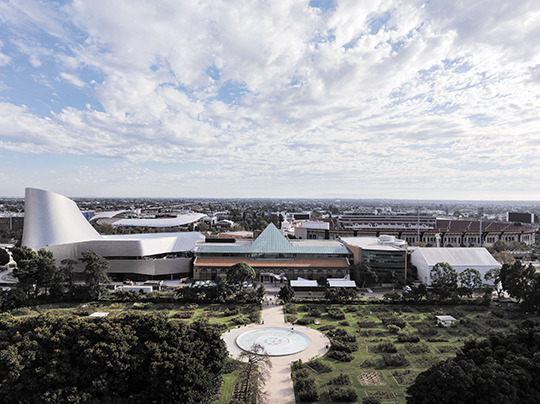
SAMUEL OSCHIN AIR AND SPACE CENTER (on left,) home of the Space Shuttle Endeavour at the California Science Center.
Courtesy Samuel Oschin Air and Space Center.
Photo © Mike Kelley
By Helene Seifer
Visitors gather in front of a screen in the new Samuel Oschin Air and Space Center. The room darkens. A stirring video begins, showing the Space Shuttle Endeavor moments before its final liftoff. Then three, two, one! A loud blast and the rocket launches, smoke billowing on-screen and off. Soon, the screen disappears, the wall slides open, and the smoke dissipates, revealing the Samuel Oschin Space Shuttle Gallery and its star attraction: the imposing Endeavour, poised as though ready for its next mission. It’s a thrilling introduction to the majesty and wonder of space flight—a wonder that’s meant to spark curiosity and inspire children to pursue careers in science, technology, engineering, or math.
The space shuttles were the first reusable space vehicles, enabling each to perform multiple missions. Endeavour, whose name, chosen in a nationwide contest, is for British explorer Capt. Cook’s ship, completed 25 space flights before NASA ended the 30-year space shuttle program in 2011. Endeavour’s significant achievements included installing new lenses on the Hubble Space Telescope. Standing nearly 20 stories tall, the 185-foot Shuttle’s stacked configuration towers over visitors as they circle it from the floor, pass under the impressive thrusters, or take a walkway or glass elevator to glimpse interior spaces. Endeavour is the only space shuttle in the world that is exhibited in vertical launch formation, with solid rocket boosters and external tank.
Opening Fri., Nov. 13, The Samuel Oschin Air and Space Center, named for the lead donor, the Mr. and Mrs. Samuel Oschin Family Foundation, displays over 100 artifacts and an equal number of hands-on exhibits. The Center consists of three sections, the final one being the Samuel Oschin Space Shuttle Gallery. Besides the singular attraction of the Endeavour itself, the Gallery contains an interactive replica flight deck, information about all 135 space shuttle missions, and an 11.5-foot tubular slide with a 45-foot drop that simulates a shuttle’s reentry into the earth’s atmosphere, complete with sonic booms.
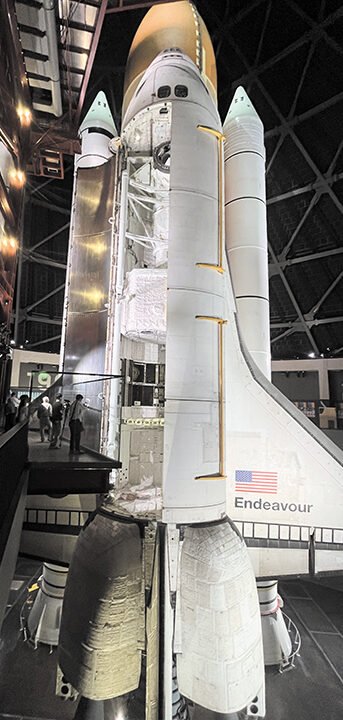
SPACE SHUTTLE ENDEAVOUR in launch position, complete with solid rocket boosters and external tank.
Courtesy California
Science Center
The other two sections are the Korean Air Aviation Gallery, which documents the evolution of flight with approximately 25 aircraft, and the Kent Kresa Space Gallery, which focuses on robots and humans in space, showcasing the Apollo-Soyuz Command Module, Gemini 11 capsule, and the Space X Dragon capsule.
The Space Center is housed in the California Science Center and was one of four museums awarded a retired space shuttle from the National Aeronautics and Space Administration in 2012. Of 200 eligible aviation museums in the United States, 29 museums applied for one of four existing shuttles (two, the Challenger and the Columbia, were destroyed in tragic accidents.)
In selecting the recipients, NASA evaluated proposals on several criteria, including educational value, fundraising ability, and the institution’s reach. The Science Center has a robust commitment to education, and their proposal for the unique Endeavour vertical display cemented their reputation for engaging exhibits. As of June 2026, $410,000 of the $450,000 goal for the 200,000-square-foot facility has been raised. The Science Center is the ninth most-visited museum in the United States, with nearly two million attendees a year, and the second most visited science museum in the country. Also considered were regional connections to the space program—and every NASA space shuttle orbiter, including the Endeavour, was manufactured and assembled in Southern California.
The other three space shuttles were distributed along the East Coast: Discovery was delivered to the Steven F. Udver-Hazy Center, part of the Smithsonian National Air and Space Museum in Virginia; Atlantis went to the Kennedy Space Center Visitor Complex in Florida; and the Enterprise landed in New York City at the Intrepid Sea, Air and Space Museum.
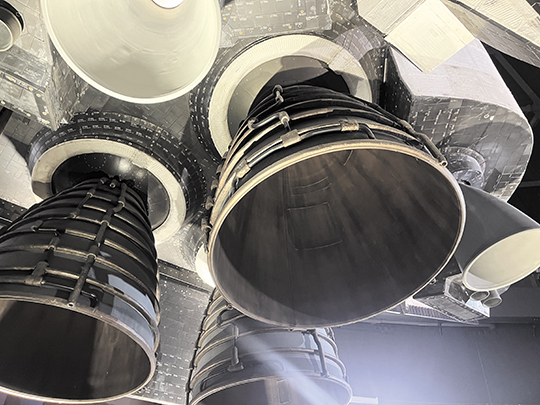
ENORMOUS ROCKET THRUSTERS on the Space Shuttle Endeavour are impressive when viewed up close.
The Endeavour’s arrival electrified California. Thousands gathered to watch its low altitude flyover atop a Boeing 747, posting iconic photos online of the Shuttle going past the Golden Gate Bridge and the Hollywood sign, before landing at Los Angeles International Airport Sept. 21, 2012. An estimated 1.5 million people cheered the shuttle on its 12-mile journey through city streets to the Science Center. Now, 14 years later, the Endeavour is magnificently launched in its new home.
The Samuel Oschin Air and Space Center at the California Science Center; 700 Exposition Park Dr.; californiasciencecenter.org; 323-724-3623. Opens to the public Fri., Nov. 13. Free admission, but timed ticket reservations are required for the Space Center.
Editor’s note: Margaret Hamilton, the first woman software engineer at NASA, who developed software for the Apollo moon missions and Skylab, died Sept. 30 at age 90. Her pioneering work was critical to the Space Shuttle program’s success.
Category: Entertainment