Peacocks and piña coladas: Route 66 is right here in L.A.
By Mara Fisher
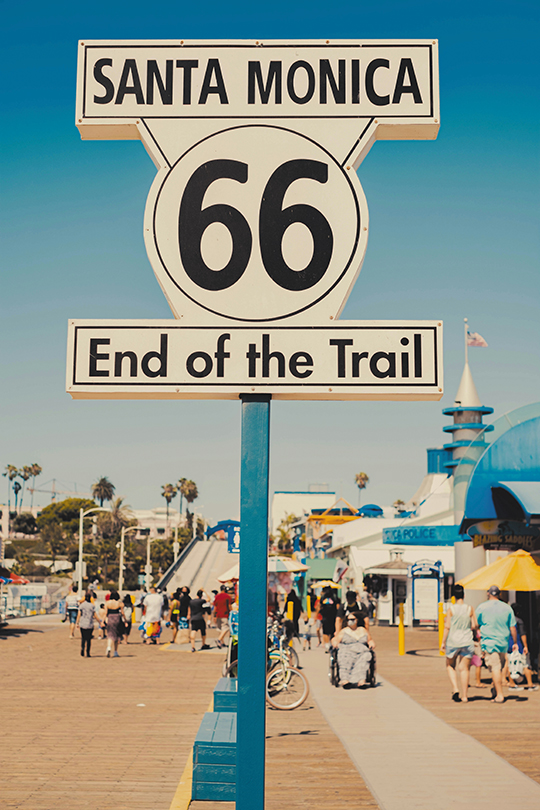
ENTHUSIASTS have adopted the Santa Monica Pier as its symbolic “end of the trail.”
If ever a road was loved, it’s Route 66. The “Main Street of America” turns 100 this year, marking a century of defining how Americans travel while enshrining a dream of the nation’s distant past.
Opened Nov. 11, 1926, the continuous 2,448-mile highway stitched together historic trails and the existing main streets of rural towns and urban centers, running through eight states from Chicago to Los Angeles.
In the 1930s, waves of families fled the Dust Bowl along the highway, heading toward California with the dream of a better future, like so many who head west. John Steinbeck’s 1939 “The Grapes of Wrath” chronicles the story of one such family, famously coining the nickname the “Mother Road,” and, perhaps more poignantly, the “Road of Flight.”
When the U.S. entered World War II, Route 66 provided passage for military transports heading toward ports. In the glory days that followed, the highway welcomed countless family road trips as mass car ownership and a rise in paid vacation leave minted a new national pastime.
Since then, Route 66 has loomed large in the American imagination, beckoning us with the promise of open road and endless sky. Though it was officially decommissioned in 1985, 85% of the original route is still drivable today, and thousands of travelers cruise the road each year to take in its midcentury architecture and offbeat roadside attractions.
If you’ve ever dreamed of driving Route 66, chances are high that you’ve already hopped on and off the Mother Road plenty. With its western terminus located at the intersection of Lincoln and Olympic boulevards in Santa Monica, the road travels across the entirety of Los Angeles County along some of our most trafficked thoroughfares. And since the road stops short of the big, blue Pacific, enthusiasts have adopted the Santa Monica Pier as its symbolic “end of the trail.”
From east to west, here are a few of our favorite local Route 66 “roadside attractions” to get you in the spirit.
Parlay with peacocks at the L.A. County Arboretum
This 127-acre botanical garden along the Colorado Boulevard stretch of Route 66 sits on land once owned by businessman Elias Jackson “Lucky” Baldwin, founder of the city of Arcadia. Come for the extensive gardens and original 1885 jewel-box Queen Anne Cottage and stay for the famous peacocks that roam its grounds, descendants of an ostentation of peafowl imported by Baldwin from India in 1879. There’s no shortage of happenings to keep you coming back, including forest bathing, bird walks, landscape design classes, Shakespeare in the garden, outdoor movies, and the not-to-be-missed Ohara L.A. Ikebana Exhibit, taking place Sun., Oct. 24, to Sat., Oct 25.
The Los Angeles County Arboretum and Botanic Garden; 301 N. Baldwin Ave., Arcadia; arboretum.org.
Get weird at the Pasadena Doo Dah Parade
Known as the “twisted sister” of Pasadena’s Rose Parade, this jubilant ode to irreverence takes place on the Colorado stretch of Route 66 Sun., Nov. 22, starting at 11 a.m. First held in 1978, the Doo Dah Parade brings together “all things eccentric and groovy,” with past troupes of marchers sporting such titles as Conehead Rocket Sled, Hippie Cream, The BBQ & Hibachi Marching Grill Team, The Original Synchronized Briefcase Drill Team, and The Pen Clicking Band. With some parades skipped in recent years due to the COVID-19 pandemic and 2025 Eaton Fire, this year’s is sure to be momentous, with a few local tributes to the Route 66 Centennial in the mix.
The Pasadena Doo Dah Parade; exact location to be announced. Visit pasadenadoodahparade.info for updates.
Tuck in to a steak frites at The Black Cat…
Here’s a Route 66 stop with a double dose of history. Opened as a gay bar in 1966, The Black Cat became the site of the first documented gay rights demonstration in the U.S. when, on Feb. 11, 1967, several hundred protestors gathered in response to a violent police raid that targeted New Year’s Eve revelers there several weeks earlier. The watering hole closed later that year, but its Art Deco-style building went on to house a succession of gay bars through the decades, eventually reopening in 2012 as a bar and restaurant donning the original name. Today a Los Angeles Historic-Cultural Monument, The Black Cat commemorates this history with a plaque outside and framed photos on the walls of demonstrators who marched on that era-defining February day.
The Black Cat; 3909 W. Sunset Blvd.; theblackcatla.com
…or a piña colada at The Formosa Cafe
A little ways down the Mother Road is this grand dame, which also celebrated a recent centennial. Opened in 1925 by prizefighter Jimmy Bernstein, “The Red Spot,” as it was called at the time, was a lunch counter housed in an original Red Car from L.A.’s fabled trolley system. Still part of the restaurant today, the 1904 car is the oldest surviving one in existence. The Formosa Cafe reopened in 2019 to the delight of barflies and hungry patrons, who now sip mai tais and sup on chow mein, a menu mainstay since at least as far back as 1949. Make sure to ask for a booth in the original trolley car.
The Formosa Cafe; 7156 Santa Monica Blvd., West Hollywood; theformosacafe.com.
Live it up at Hollywood Forever Cemetery
That’s right—the 90,000 lives laid to rest at Hollywood Forever are bonafide Route 66 residents. But the star-studded cemetery has plenty to delight the living, too. Pay tribute to loved ones lost at their 27th annual Dia de los Muertos celebration (the largest in the world outside of Mexico) Sat, Oct. 24; take in a concert at their Masonic Lodge; or enjoy some cinema under the stars at a Cinespia screening on the cemetery’s Fairbanks Lawn. Coming up this month are “Josie and the Pussycats” Sat., Sept. 5; “The Sandlot” Sun., Sept. 6; and “Goodfellas” Sat., Sept. 12; with an October lineup sure to be announced any day now at cinespia.org.
Hollywood Forever; 6000 Santa Monica Blvd.; hollywoodforever.com.
See your idols up close at the Troubadour
With only up to 500 tickets sold each night, this intimate concert venue, opened in 1957, makes being serenaded by your favorite superstar feel like stumbling upon a coffeehouse up-and-comer, with many major acts blessing the room with their presence long after they’ve topped the charts. If these walls could talk, they would echo the sounds of some of the most beloved acts in recent memory, like Elton John, Joni Mitchell, No Doubt, Radiohead (while touring their 1997 album “OK Computer”—chills!), The Strokes, and even BTS. While I’m too out of touch to know any of the artists on their upcoming roster, you (or your kids) might.
The Troubadour; 9081 Santa Monica Blvd., West Hollywood; troubadour.com.
Bonus: Make your snail mail extra snazzy
In May the U.S. Postal Service debuted a set of eight stamps commemorating the Route 66 Centennial, citing the two entities’ “shared purpose of binding the nation together.” Each design shows a site from the states through which the roadway runs, like the classic midcentury neon sign of Munger-Moss Motel in Lebanon, Missouri, and the Art Deco-style Tower Station and U-Drop Inn Café in Shamrock, Texas. Pick them up at your local post office or find them online at usps.com.
Category: Real Estate