Mesmerizing world of jellies at Aquarium of the Pacific
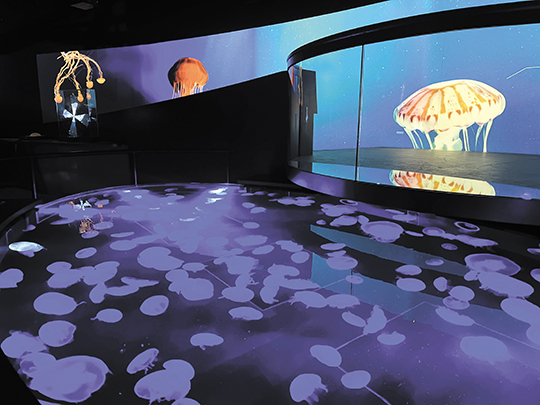
JELLY DREAMSCAPES is a magical exhibit of hundreds of mesmerizing jellies.
By Helene Seifer
In the aptly named “Jelly Dreamscapes,” at the Aquarium of the Pacific, mesmerizing jellyfish float and swirl like little ballerinas of the sea. It’s easy to lose track of time while gazing at the dramatically lit umbrella-shaped creatures from around the world. Hundreds of live jellies in every size and color palette populate the beautiful displaysm and soothing music adds to the magical atmosphere. Outside of the special exhibition space, visitors can gently touch glistening translucent moon jellies bobbing in a separate tank on an exterior terrace.
The sea jellies and ctenophores (jellyfish-like planktonic animals) in the exhibit represent one of the most diverse collections of jellyfish in the country. There are approximately 200 species of true jellies in the world; the Aquarium of the Pacific staff propagates and raises more than 40 species of the gelatinous invertebrates and grows the food each species needs to survive. Although commonly called jellyfish, the spineless sea creatures are not fish and are more accurately referred to as jellies or sea jellies.
In spite of their delicate appearance, jellies are survivors. They are among earth’s oldest animals—geologic records indicate they have roamed the seas for over 500 million years, predating dinosaurs by more than 250 million years. Ctenophores are even older. Remarkably diverse, jellies and ctenophores are found in every ocean, in shallow waters as well as at great depths. Some are as small as a pinky fingernail; others can unfurl their tentacles to lengths rivaling that of a blue whale, up to 90 feet! Sea jellies lack a heart, brain, or gills, but are guided by a collection of sensory nerve cells and have stingers to stun their prey, commonly zooplankton, small crustaceans, fish, or other jellies. Jellyfish gracefully propel by pulsing their parasol-like bells.
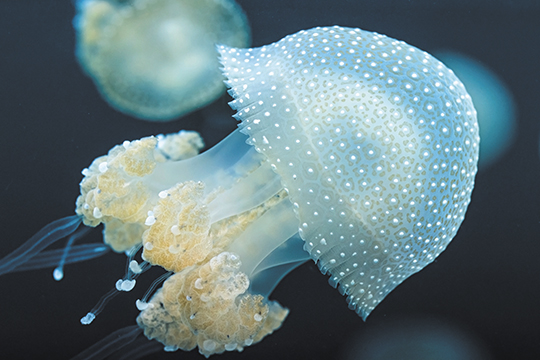
Australian spotted jelly
© Aquarium of the Pacific/Robin Riggs.
Photo by Robin Riggs
Most, but not all, jellies are either male or female. (Some change midway through life, some are hermaphrodites.) Jellies reproduce through a combination of fertilized eggs and cloning. Eggs and sperm are released into the water. Once eggs are fertilized, the resulting larva attaches to a rock or other hard surface on the ocean floor and begins to clone itself, eventually becoming baby jellies.
Jellies are 95% water and therefore each one has limited nutritional value, but they are nevertheless a food source for many predators. They usually travel in large groups, or smacks, making it easy for fish, sea turtles, crustaceans, sea birds, and marine mammals to capture a large number at once, compounding their nutritional value. Humans, too, consume them; jellyfish salad is a popular dish in Korea and China.
On average, these fascinating animals will live one year, but in their short lives they are not just a vital part of the ocean’s ecosystem, they also provide both beauty and knowledge. Some jellies are like the proverbial canary in the coal mine, the first indicator that something has gone wrong, since nerves in their outer layer react to changes in the water chemistry.
Additionally, the properties of the collagen found in their bells show promise for medicinal applications in areas of anti-aging, wound healing, reconstructive medicine, and brain health.
It’s not necessary to do the research to gain some medical benefits. Immerse yourself in the exhibit, follow a jelly as it glides around its aquarium—pulsing its bell, trailing its tentacles like so much Rapunzel hair—and enter the calming jelly dreamscape.
“Jelly Dreamscapes;” Aquarium of the Pacific; 100 Aquarium Way, Long Beach; aquariumofpacific.org; 562-590-3100. Exhibit runs through Fri., April 30, 2027. Tickets: Adults $49.95, Seniors $46.95, Children $34.95, 2 and under free. Reservations required.
Category: Entertainment