


MacArthur Park is almost picture perfect again
By Nona Sue Friedman
The blight that for decades has been MacArthur Park is now clean—so clean it’s almost unrecognizable. In an email from Councilmember Eunisses Hernandez, who oversees the area in her Council District 1, “What you are seeing today is the result of nearly four years of sustained investment in MacArthur Park and the surrounding community.
The park’s most recent decline started in the 80s when prostitution, violent crime, gangs, and drug sales ran rampant. During this time the area west of downtown known as Westlake, also had a major influx of immigrants fleeing Central American countries, making it the second densest area in L.A. In more recent years, the park was filled with drug addicts, primarily high on fentanyl, ringed with street vendors, and homeless people wandering through.
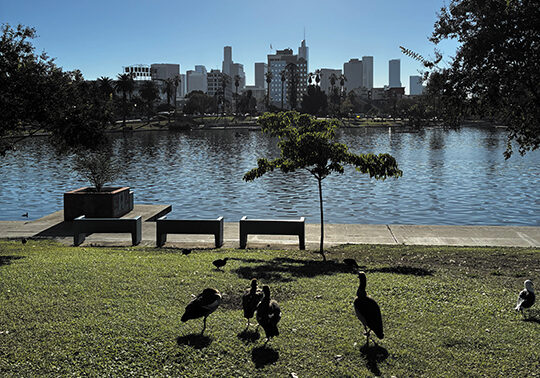
VIEW OF THE LAKE at MacArthur Park with downtown.
Through a variety of city and county funds and grants, CD1 has invested more than $27 million to make the metamorphosis happen, which includes teams to clean the area six days a week, regular power washing, street medicine, overdose response, Peace Ambassadors and so much more.
Hernandez’s approach to keeping the park accessible include clean-up services continually running and adding programs to bring kids and families back to the park, such as year-round free programming at Levitt Pavilion and Fall Friday Nights. She also oversees a long-term project costing roughly $40 million to improve the park’s lake, provide shaded seating, walking paths, and new landscaping. Also slated for installation is a $2.3 million fence around the park that is to begin construction this month and continue through spring of 2027. It will be locked at night.
One morning, Richard, a self-described Aquarius who lives downtown and rides his bike daily to MacArthur Park for his “water fix,” said the park has improved significantly. “There used to be drug addicts all over the place. Now it’s clean.”
What happened to all the chaos?
Although the clean-up didn’t happen overnight, it sort of feels that way. Since the summer, residents in the Chronicle’s distribution area have complained of seeing additional homeless people in their neighborhoods and seeing more drug paraphernalia on sidewalks. Their first instinct was to blame it on the clean-up at MacArthur Park. However, the Los Angeles Police Department doesn’t concur. Senior Lead Officer Daniel Chavez of Olympic Division said there has been a slight increase just west of MacArthur Park but otherwise he hasn’t noticed a difference. SLO Tyler Shuck of Wilshire Division said it would be purely speculation.
Olympic Division’s Capt. Rachel Rodriguez said the biggest change her district has witnessed is that street vending has increased. Before arresting vendors—who sell anything from hot dogs to imitation designer purses to tacos—Wilshire will have education sessions to inform the merchants of their rights and the rules and regulations surrounding street vending in Los Angeles.
Some history
So you know how far MacArthur Park has fallen since its creation more than 100 years ago, here’s a brief history.
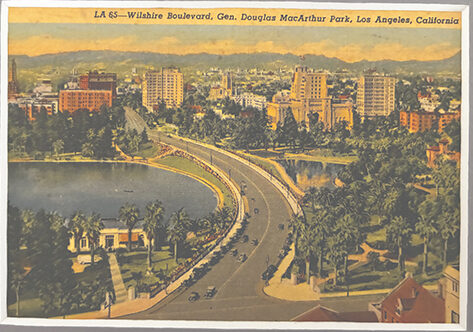
ILLUSTRATED POSTCARD OF MacArthur Park from 1950.
In the 1880s, Los Angeles bought 35 acres of what was then a mud hole from George S. Patton, father of the famous general. Soon after the purchase, city planners had a vision for the land. They wanted to model it after Paris’s Avenue des Champs-Elysées. And that’s what they did.
Westlake Park, its original name, opened in 1890 sporting a lake with a Victorian boat house and boats to rent. Landscaping included local shrubs combined with exotic plants and flower gardens. Paths meandered through the lush landscape.
The park was on the western edge of downtown. Residents and visitors would take the Seventh Street streetcar to the magnificent European inspired urban oasis. The area around it started boasting luxury hotels and residences. Westlake became a renowned destination.
In the 1930s, the park started to slowly decline. A well-known businessman, Gaylord Wilshire, successfully lobbied to have Wilshire Boulevard bisect the park. After that, it changed the natural ecosystem and created more noise and pollution.
In 1942, the park, which is bordered by Sixth, Seventh, Alvarado and Park View streets, was officially renamed MacArthur Park as a tribute to Gen. Douglas MacArthur. Many believe the name change tarnished the park’s majestic charms. Maybe the current efforts are wiping away the tarnish and it will one day be a bright gem in Los Angeles again.
Category: News
