Men of Larchmont
David Levinson: Connecting people through helping
By Helene Seifer
David Levinson, a long-time Hancock Park resident and former screenwriter, made a profound career switch from pursuing Hollywood gold to helping those in need. At first, he juggled both jobs when he founded what would become Big Sunday in 1999. Originally a single day of service run out of Temple Israel of Hollywood, it immediately struck a chord. Some 200 people showed up that first year to volunteer at 19 nonprofits. Today Levinson is dedicated full-time to Big Sunday, which incorporated in 2008, has a spacious campus in Hollywood, 13 full-time employees, a passel of consultants, and thousands of volunteers. It has expanded to a year-round center for assisting people and organizations throughout the Los Angeles area and beyond.
His motivation for starting Big Sunday is unexpected. He explained, “I did not start Big Sunday out of altruism. I started it out of depression and anger.” Levinson had gotten frustrated with the television writing process—so many meetings, yet so little got done—and realized that fulfilling the needs in the community fulfilled a need in him.
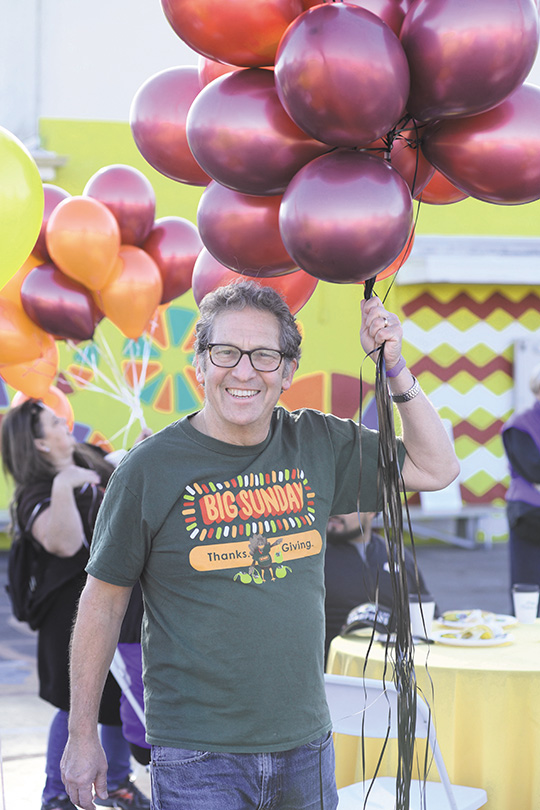
David Levinson
Under Founding Director Levinson’s stewardship, Big Sunday has received immense neighborhood support, including from the Rosenthal Family Foundation, Marlborough School, Windsor Square Association, and Paramount Pictures. “We’ve worked with the L.A. Tennis Club, the Wilshire Rotary, Chevalier’s Books, and Levain Bakery, as well as realtors,” all crucial to allowing Big Sunday to fulfill roughly 2,000 requests annually.
The nonprofit performs small acts of kindness, such as organizing a volunteer choir to bring holiday cheer to nursing homes, and enacts larger endeavors, including city-wide book drives for schools and libraries. It provides Thanksgiving dinners to 18,000 people and it responds to requests for help from hundreds of cities worldwide, from Nashville to Shanghai.
Firmly believing that everyone has something to give, Levinson also designated a weekly time for those with developmental challenges to volunteer on accessible projects in a welcoming space. Feeling welcomed is a large part of Levinson’s Big Sunday philosophy; those helping might start the day with a free breakfast or finish with a dance party, and volunteers are encouraged to become friends. Building community is part of Big Sunday’s mission.
Levinson and his wife, Ellie Herman, a writer and teacher, were first introduced to the Larchmont community when they moved to Los Angeles in 1984 and initially stayed with Herman’s uncle on Rossmore Avenue. They lived in nearby neighborhoods for a little over a decade, then moved with their three young children to a fixer in Hancock Park in 1996. “We had no heat for the first six weeks,” Levinson remembered. “We all wore parkas, gloves, and hats!”
“It’s a great house; both our daughters got married in the backyard. We have great neighbors. It was a great place to raise the kids,” Levinson stated.
Larchmont Boulevard holds a central place in his family’s life. “I’ve eaten everywhere there, Village Pizzeria, Great White, ate at Sam’s Bagels about a zillion times. There’s no place I haven’t been to 1,000 times. Chevalier’s is a great bookstore. Larchmont was the first place we let our kids go on their own, first just on one side of the street.” A member of the Tennis Club, he trains on their ellipticals five days a week. He admitted, “I’ve recruited board members at the gym. I’m shameless! There are a lot of good people in the neighborhood. It’s a true community.”
Levinson connects with the community in other ways, as well. He and his wife have hosted several art exhibits of local artists at their home. He is organizing a Big Sunday arts weekend in October because so many people in the Big Sunday community have talent. He is also a photographer and plans to have a pop-up exhibit somewhere in the neighborhood in February 2027 with a painter friend.
In keeping with Big Sunday’s philosophy of connecting people through helping, Levinson is grateful for how the organization has enhanced his own life. He said, “I’ve gotten to know so many amazing people or gotten to know them better. I consider myself very lucky to have been on this ride.”
AYSO Commissioner keeps joy in the game
By Jack Brownlee
I often feel that the world nowadays has a sort of reckless speed to it. It’s a blind desire to optimize and maximize that often sacrifices connection, appreciation, and positivity. But sitting down and chatting with Kurt Muller, I was reminded that it hasn’t all gone that way. There are good men, like Muller, who work unwaveringly to make sure the value of slowing it down, enjoying the process of bettering yourself, and delighting in the community of others is preserved both now and into the future.
Muller, who lives here in Larchmont, is the commissioner for the Hollywood-Wilshire region of the American Youth Soccer Organization, the oldest national youth soccer program in the country. AYSO was founded in Torrance in the 1960s and now has over 900 chapters nationwide, allowing boys and girls of all ages to enjoy the sport. The Hollywood-Wilshire chapter, founded in 1976, celebrates its 50th anniversary this year. The organization is entirely run by volunteers like Muller, who began coaching AYSO teams when his daughters were part of the program.
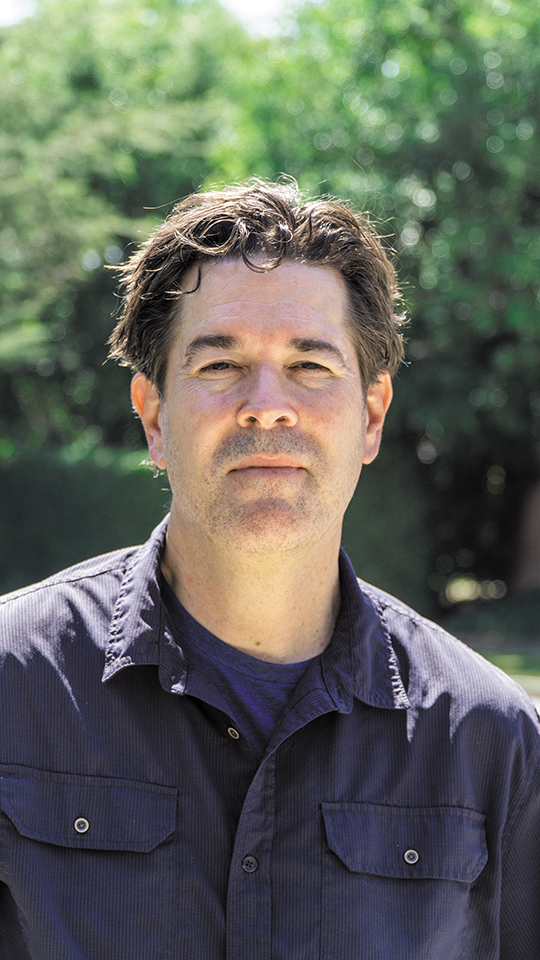
Kurt Muller
“Last year [Hollywood-Wilshire] had 150 volunteers. That’s people in the community that are giving up their time,” said Muller. “I went out there for my kids, and you start to realize that you’re making an impact on other kids, and, in effect, the community.”
In 2017, Muller became the regional commissioner. “It is kind of like a tradition,” he said. “You’re passing on your role to the next parent, or whoever wants to take on that responsibility, entrusting it to the volunteers to carry on.”
After a few years manning the helm, Muller considered stepping back. Then the Covid-19 pandemic hit. AYSO numbers dropped drastically, both in terms of players signing up and community members volunteering. Hollywood-Wilshire didn’t even have an official season in 2020. Muller decided to stay on and right the ship. While pre-pandemic numbers haven’t quite been reached yet, the bounce back has been impressive nonetheless. “It was really important to me,” said Muller. “I really saw the impact of giving kids something positive to do, you know? Getting outside.”
Muller grew up in Tarzana and attended Crespi High School before heading to Cal Poly in San Luis Obispo, where he majored in business. Nowadays, he works in sales for a boutique college apparel company. What really moved him to stick with AYSO were the organization’s central philosophies.
There are six maxims that set AYSO apart from other youth sports organizations. Balanced teams, positive coaching, good sportsmanship, and open registration are all included, but the foremost is that everyone plays. Being on an AYSO team means you get experience both practicing and playing, no matter your confidence or skill level.
Nowadays, youth sports can be intense. Parents often push their children into hyper-competitive (not to mention expensive) club sport programs that focus solely on skill development. During Muller’s tenure as commissioner, he’s seen this culture creep into AYSO.
“Having that commitment to be on a club team, it’s started younger and younger,” he reflected. “I think it requires so much of young kids that it doesn’t allow them to do other things, and it may not even be what they want. With a rec program, it allows you to make those decisions on your own, as a player or as a parent.” AYSO National recently added its sixth philosophy, “player development,” along with a higher-level club division for anyone interested.
“We’ve always encouraged kids to stay in the program as long as you can, and then, you know, you’ll naturally find that next level as you get older,” said Muller. “But I think in those four years, especially when you’re 8, 9, 10, 11 years old, you definitely want to be a part of something that you’re playing with your friends. There’s not this pressure to win, and you’re guaranteed playing time. Things like that are important.”
I asked him his favorite story from his time at AYSO so far, and it brought him back to when he was coaching his daughters’ teams. “Playing a game on a cold, rainy day against a team that was way better than us,” he said with a laugh. “We were just getting killed. But somehow, we were able to have the kids smiling at the end…That’s ultimately the key. Kids can lose games and feel terrible about themselves, so if you can turn something around like that into something positive, I mean, that’s a core memory.”
Positivity can feel hard to come by nowadays, and often when we see it, it feels more serendipitous than intentional.
But if you know where to look, you’ll find men like Kurt Muller—men who wake up every morning and give up their time and energy in the pursuit of joy and community for the next generation.
And at the end of the day, those are the things that will last far into the future.
Category: People