‘I try to unite folks and create a vision’
City Councilman Hugo Soto-Martínez has something to be proud of. The incumbent won the June primary by a landslide, with nearly 70% of the ballots cast in the 13th District.
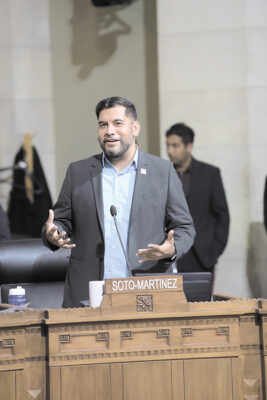
“I’m very excited, and, more than anything, relieved…We’re excited at this resounding vote,” the Councilman told the Chronicle in an interview last month.
He had hoped to include a controversial measure—expanding voting rights to noncitizens—on the upcoming November ballot. A year-long review by the Charter Reform Commission “gave us an opportunity to explore that, but based on significant push back, [the measure] was pulled…” he explained.
His reasons for pulling the measure? “I didn’t want to divide the community. We’ll keep working on it. It’s an important discussion.”
Another of his top priorities, LAPD reform, was nixed at the last minute by his colleagues on the Council.
“The public may think the City Council can set LAPD policy but that’s simply not the case,” he said.
“Ballooning liability is a serious restraint on our budget,” he said, referring to huge payouts resulting from civil rights violations to police shootings and excessive force. And there’s the approximately $250 million paid in overtime annually.
He plans to continue working on these two items and bringing them up at the next election cycle in 2028 in the same manner he approaches other issues—drawing on his experience working as a union leader.
“I credit 16 years in the union with skillssets that have been very valuable for me. An organizer works with the input of various groups of people and to bring as many people together. I try to be that leader to unite folks and create a vision. It’s hard work. It requires compromise.”
The L.A. native, raised by Mexican immigrants and street vendors, entered the workforce at 16 when his father became disabled. He put himself through college and helped organize, and win, a union contract, which led to his career as a labor organizer. Since his foray into politics, he’s championed community-driven policies. He helped make Los Angeles a Sanctuary City, and he passed the biggest package of tenant protections in a generation. “It’s all part of his mission to uplift those who’ve historically been left out of L.A.’s prosperity,” according to his website.
He has been linked to the “Mamdami Effect,” referring to a national social shift triggered by the New York City mayor, a member of the Democratic Socialists of America.
In Larchmont, Hancock Park, and other neighborhoods Soto-Martínez represents, he’s working to keep the lights on—literally.
Defunct streetlights, often the result of copper wire theft, are an example of how so much in the city is interrelated. Because of mounting liabilities and overtime costs the general fund is being depleted.
“Luckily,” discretionary funds pay for a dedicated team that has been working in CD13 to keep the lights working…
“But in the long term, we need to build trust with the community…educate the public…and unify people”
He’s not surprised a lighting assessment on the June 2 primary ballot lost, and he expects more of the same, “until the public feels confident that we will use their money in an effective way,” he said.
On a more positive note, a long-standing issue of sex trafficking on Western Avenue near Ridgewood Place seems to have eased.
“When there was a police force on Figueroa [sex traffickers] just moved to Western,” said Soto-Martínez. That’s when CD 13 created a “holistic way… We listened to the community, we repaired lights, trimmed trees.” The councilman’s team also collaborated with Journey Out, a nonprofit which helps victims and survivors of the trade. They also worked with the LAPD, the neighboring council district, and the L.A. County Supervisor offices.
Then there’s homelessness. “It’s a complicated issue, but it’s also not complicated,” he said. “Some 700 evictions are filed every month, which is the leading cause of homelessness.”
Those who lose their homes amount to 60% of people living on the street, in their cars, and in tents.
“Another 30% is mental health and addiction, and another 10% domestic violence.
“There’s a lot we can do. We’ve got to raise the wages, and we’ve done that and lowered rents.”
We also need to build more housing, he said. The councilman is in favor of Senate Bill 79, passed July 1, which allows multi-story housing near major transit, and the Citywide Housing Incentive Program (CHIP), which expands affordable housing through a set of ordinances.
“Whether its SB79, or CHIP, or the parking lot on Larchmont Boulevard [from where a developer sought to remove the Larchmont Farmers Market], every single issue has to do with planning decisions that would change the character of the community. And every single time, we’ve leaned into the community, especially with the parking lot.”
On that note, he’s also a fan of Livable Community, a grassroots initiative working to bring “gentle density” of 3-5 stories to Upper Larchmont Boulevard. “It’s a great vision for the community,” the councilman said.
Some area residents had reservations about Soto-Martínez when he ran for office four years ago—he is a social democrat, after all. But judging by the recent election, he’s since won some hearts and minds.
Politics is fickle, and things can change. But for now, he has cause for celebration. Then he’s getting back to work—on both sides of the aisle.
Category: News