The opposite of Bear Land: a closer look at Antarctica
 Picture Antarctica: white, cold, ice for miles. Penguins and seals, yes. Polar bears—not a one. You may be aware that it’s the least populated continent on Earth, with zero permanent residents. You might also know that, as the world’s largest desert, it’s where NASA sends astronauts to prepare for the isolation of long-duration space missions. But for Aristotle, in 350 B.C., it was merely a hunch. Well aware of the Arctic Circle in the north (and an early proponent of the spherical Earth), he wrote: “…there must be a region bearing the same relation to the southern pole as the place we live in bears to our pole…”
In later centuries, maps would depict the mythical, as-yet-undiscovered continent—called “Terra Australis,” Latin for “Southern Land”—as a vague mass covering the South Pole. Up through the 18th century, many explorers even believed that parts of Terra Australis sat at a high enough latitude to have a temperate climate. That dream was dashed in 1773, however, when Capt. James Cook ventured closer to the continent than anyone had ever before, crossing the Antarctic Circle. Halted by ice less than one day’s sail from the coast of Antarctica, he wrote, “Should anyone possess the resolution and the fortitude to elucidate this point by pushing yet further south than I have done, I shall not envy him the fame of his discovery, but I make bold that the world will derive no benefit from it.”
Without the possibility of colonization or trade exploitation, interest in finding Terra Australis waned, and in 1794, the name got snatched and polished up by the southernmost continent yet known to humans: “Australia.” Known for centuries by its Dutch name, “New Holland,” the continent received renewed attention when the new moniker was championed by British explorer Matthew Flinders, who wrote: “There is no probability that any other detached body of land, of nearly equal extent, will ever be found in a more southern latitude.”
Flinders was able to live out his days with dignity, perishing just six years short of 1820, when the first explorers finally caught sight of the seventh continent. It would be another 75 years, however, until the first confirmed landing. On Jan. 24, 1895, Norwegian explorers Henrik Bull and Carsten Borchgrevink sailed a ship aptly named the Antarctic to Cape Adare in East Antarctica. As Capt. Bull readied himself to step ashore as the “first man on the last continent,” Borchgrevink leaped from the back of the boat over the side on the pretense of pulling the vessel closer to shore, thereby claiming the honor for himself.
With “Terra Australis” securely in the rearview, the name “Antarctica” arrives much like Aristotle’s hypothesis—as a counterpoint to the Arctic, its literal polar opposite. That northernmost part of the globe is named after “arktos,” the Greek word for “bear,” owing to the Great Bear constellation’s positioning in the northern celestial hemisphere.
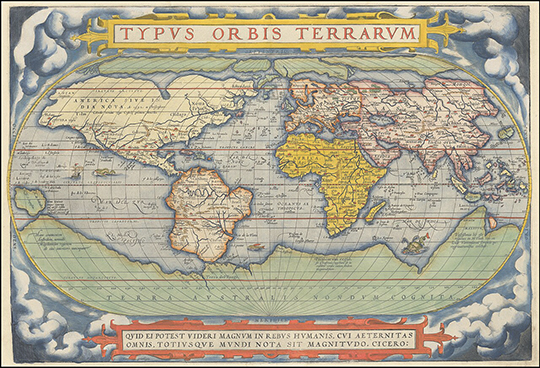
WORLD MAP FROM 1572 depicts the then undiscovered continent of Antarctica as an enormous land mass covering a significant portion of the Southern Hemisphere.
Image via Wikimedia Commons.
Over a century after that first landing, place names in Antarctica are essentially a who’s who of the figures that have braved its icy plateau. There are features named for explorers from dozens of countries, as well as their ships, their financiers, and their wives (such as the Adélie penguin, named for the spouse of French explorer Jules Dumont d’Urville), in addition to, not least, a sled dog named Vida.
Then there are the place names that might make one question whether they’ve ventured to the seventh continent or the seventh ring of hell. On the East coast of the Antarctic Peninsula, there’s Cape Disappointment, which is adjacent to (I kid you not) Exasperation Inlet, expressing the full range of emotions experienced by those that planted their flags there. A bit further north is the bleak, forbidding landscape known as Desolation Island. Blood Falls is named for the appearance of its outflow, colored red due to a high iron oxide content. And, of course, there’s the extinct volcano known as Mount Terror (named for explorer James Clark Ross’ ship).
But for the 5,000 scientists and tourism industry workers who spend the summer in Antarctica today (the population drops to 1,000 in winter), the weather’s just fine. With 55 different countries operating research stations on the continent, there’s a robust slang vocabulary as well. Terms in the English language come from a mix of Australian, New Zealander, British, and American Antarcticans, the latter making up a whopping 28.1% of the summer population.
For seasoned residents, Antarctica is simply “The Ice,” and the quality that makes doing just about anything there a little more difficult is the “A-factor.” If you’ve spent too much time on The Ice, living in 24-hour daylight and off of penguin egg omelets (now I do kid, though eating local wildlife was only banned in the 1990s), you might be called a “bolo,” an acronym for “burnt out, left over.” An “ice wife” or “ice husband” is not unlike your work spouse, but in subzero climates. And an “Antarctic 10” is a person whose attractiveness soars in the polar expanse, though their looks might earn them a “5” rating in a more abundant dating pool.
There are the “ungone”—those who share drawn-out, heartfelt goodbyes with their other compatriots on the day they’re meant to ship back home, only to return back to base shortly thereafter due to a delayed flight. And when you do make it back to your cozy corner of the world, you may be knocked sideways with a “greenout,” the overwhelm of emotions felt upon seeing plant life for the first time in ages.
Master of those who know
On the Antarctic Peninsula, craning north toward the southern tip of Chile, lies a mountain range just southwest of Exasperation Inlet. Bookended by Madrid Dome and Crane Glacier, the ridge known as Aristotle Mountains commemorates the ancient philosopher for whom the frozen continent was a mathematical certainty. As with his pioneering writings on logic, physics, and ethics, it just took some time for the rest of us to catch up.
Category: Entertainment