A new kind of drug points to where medicine is headed
 Just this past May, the Food and Drug Administration approved a new drug named vepdegestrant (Veppanu) for a subset of patients suffering from metastatic breast cancer. First and foremost, this is a promising development for individuals with oestrogen receptor-positive, HER2-negative breast cancer. However, there is an extra layer of excitement to this news: Veppanu is the first drug of its kind (known as a PROTAC) to ever be approved by the FDA. For the remainder of the article, I will go over exactly what I mean by this and unpack all these science terms.
Let’s break it down into simple concepts: proteins are everywhere in the body. Receptors, enzymes, structural elements—they’re all made up of proteins. Many diseases stem from proteins that aren’t behaving as expected. For example, an overactive protein could lead to cancer, or a misfolded protein could lead to a neurodegenerative disease. Therefore, many existing drugs work by blocking a protein’s function.
PROTACs (which is short for proteolysis-targeting chimera) work in a completely different way. In simple terms, they stick onto a specific protein and bring it to our cell’s natural garbage-disposal system.
What is this “garbage disposal system”? In biology, when a protein needs to be destroyed by the body, this is referred to as “ubiquitination.” A faulty or misfolded protein that needs to be destroyed is first “tagged” with a little flag called an E3 ligase. This flag calls over another protein called ubiquitin, the cell’s garbage man. Basically, ubiquitin’s job is to destroy whatever the E3 is connected to.
Now let’s apply this concept to the breast cancer. Some breast cancers grow in response to estrogen signaling. Hormone therapies aim to disrupt this pathway, but cancers can evolve. ESR1 (estrogen-receptor 1) mutations can make the estrogen receptor pathway harder to disrupt and lead to treatment resistance.
So how does Veppanu work? A PROTAC drug has three parts: One end that binds the protein of interest, another end that recruits an E3 ligase, and a linker connecting those two ends.
So, translate that logic into Veppanu’s mechanism: one end binds the oestrogen receptor, one end binds the E3 ligase to tag the oestrogen receptor for degradation, and the two ends are connected by a linker to make this all possible. A PROTAC can be thought of as a little escort service which guides unwanted proteins in the body to the trash.
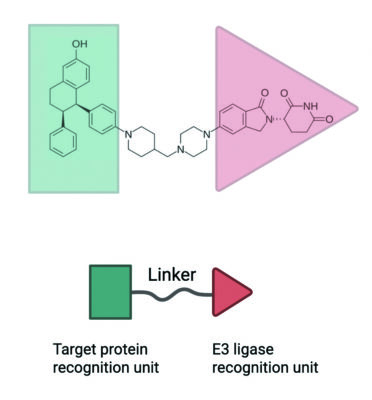
PROTAC structure.
Photo by Priscilla Duggan on BioRender.
To qualify for treatment with Veppanu, patients need the right cancer subtype and mutation profile, identified through medical testing. In clinical trials, Veppanu improved progression-free survival compared with existing therapies. This means the length of time patients lived without their cancer getting worse significantly improved. It is important to note that this does not mean the cancer was cured. It means that for the studied group of patients, the disease was held in check for longer.
The approval of the first PROTAC is exciting for several reasons. Veppanu shows us where medicine is headed: more precise diagnostics, drugs with higher biological specificity, and completely new ways of accessing targets in the body that were previously considered undruggable. As the first approved drug of its kind, Veppanu marks a turning point. Medicine is learning not only how to inhibit problematic proteins, but how to remove them. Consider the plethora of diseases caused by protein malfunction: Alzheimer’s, Parkinson’s, Huntington’s, cystic fibrosis—the list goes on. With this in mind, this step forward has promising implications for many diseases that have long been considered non-treatable.
Questions? Comments? Email pcd1130@gmail.com.
Category: News