Once upon a time, October’s sugar rush struck twice
 As we enter October, darkness cloaks the afternoon hours, a chill electrifies the air, and the promise of sinfully delicious treats awaits.
But in 1916, you didn’t have to count the hours until the end of the month to get your sugar fix. While Halloween was already gaining steam, a new holiday known as Candy Day, which took place the second Saturday of the month and was declared by (who else?) the National Confectioners Association, ensured a double helping of sweets in October. Rather than roam the neighborhood in costume, children and adults were encouraged to pull out their pocket change and make the lives of loved ones a little brighter with the blissful, eyes-closed surrender of a gifted sugary confection.
That year, you had your pick of any number of candies that have since stood the test of time. In the 1880s, candymaker George Renninger debuted the three-color Candy Corn, previously called “Chicken Feed,” to the agony or ecstasy (there’s no in-between) of trick-or-treaters and casual snackers. Chocolate magnate Milton S. Hershey launched his Kisses in 1907, named for the way the chocolate dispensing machine would delicately smooch the conveyor belt to make the candy’s signature flat-bottomed teardrop shape. Or you could grab a handful of one-cent Tootsie Rolls, a chocolate-flavored, taffy-like confection developed by Leo Hirschfield in 1908, its moniker a tribute to his 5-year-old daughter, Clara, whom he called “Tootsie.”
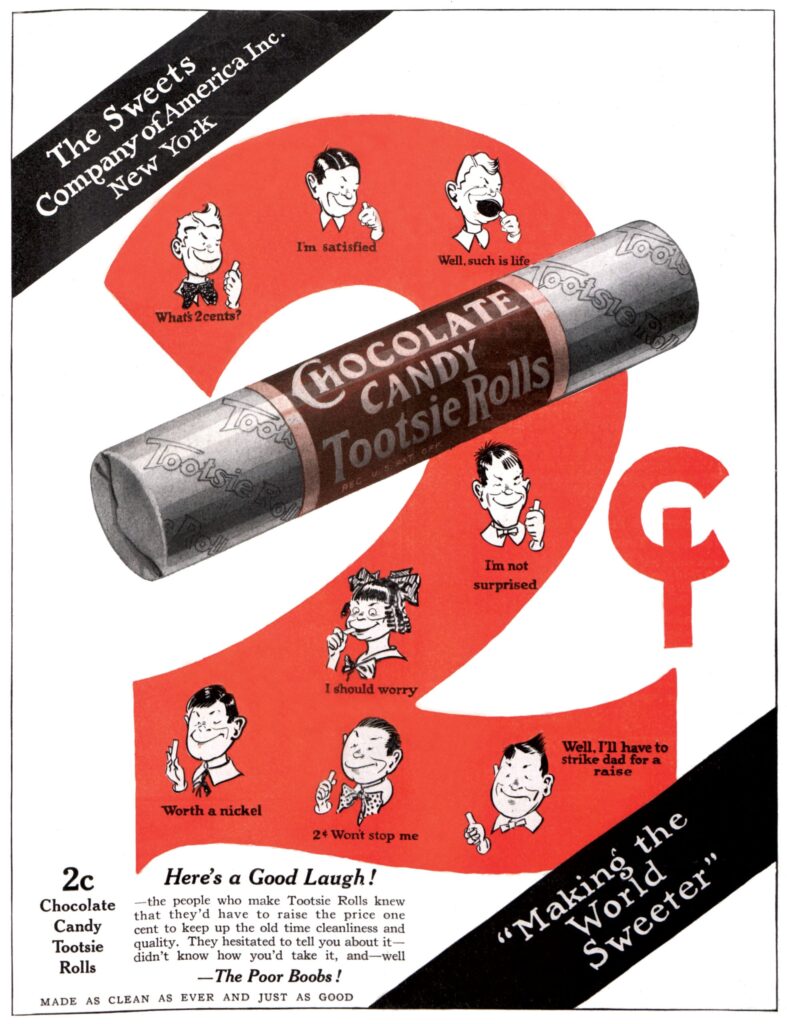
TOOTSIE ROLL advertisement from 1920.
But it took a few more years for the candy industry to really catch its stride. In 1920, Chicago-based confectioner Otto Schnering debuted “Baby Ruth,” a chocolate-covered candy bar with peanuts, caramel, and nougat that made waves when a bevy of bars—each equipped with its own tiny parachute—was dropped from a plane over the city of Pittsburgh as part of a promotional stunt.
Schnering denied to the death that his delicacy was branded to capitalize on the fame of a “home run king” of a suspiciously similar name, maintaining instead that it was a tribute to President Grover Cleveland’s daughter Ruth. By the time the candy launched, however, not only had it been over 20 years since Cleveland was in office, “Baby Ruth” wasn’t even alive, having died of diphtheria in 1904. The kerfuffle reached peak pettiness in 1926, when Babe Ruth—the baseball player this time—decided to enter the candy business himself, seeking to register “Ruth’s Home Run Candy” with the U.S. Patent and Trademark office. Schnering’s team sued, accusing the ballplayer of trying to profit from the similarity of his nickname to the wildly popular Baby Ruth candy bar.
The 1920s saw another formidable challenger enter the industry. Frank C. Mars made a splash with his first candy bar, Milky Way, which was named not for our cosmic address but instead the flavor of chocolate milkshakes. The success of the bar, made with malt-flavored nougat coated in chocolate, no doubt helped fund the purchase of the Mars family’s Milky Way Farm, in Giles County, Tennessee. With over 1,000 acres of pasture, the farm had plenty of room for the family’s horses, including their favorite, Snickers, who was immortalized with Mars’ next major hit, the chewy nougat, peanut, and caramel chocolate bar that “really satisfies.”
The Mars company’s next stroke of genius came in 1940, when Frank’s son, Forrest, teamed up with Bruce Murrie, the son of the president of Hershey, to launch colorful bite-size candy-coated chocolates named for the duo’s last initials—M&M’s. Forrest Mars claimed the idea came to him while visiting Spain during the Spanish Civil War as he watched soldiers snack on hand-held candy-coated dragées—a sugar coated nut (a convenience factor that would later prompt the slogan “Melts in your mouth, not in your hand”). The more likely inspiration was the nearly identical candy Smarties, from the British confectionary Rowntree’s, which had debuted just a few years earlier.
Rowntree’s knew a thing or two about chocolate. Founded in 1862, the York-based company introduced in 1935 a four-fingered, chocolate-covered wafer known as Chocolate Crisp, originally conceived as a bar “a man could take to work in his pack up.” The bar’s big “break” came two years later, when it was renamed “Kit Kat,” a moniker dating all the way back to a 17th-century London literary club that met at a pie shop owned by chef Christopher “Kit” Catling. The club—and Catling’s famous mutton pies—were both called “Kit Kat,” after the chef, with a comedy from 1700 noting, “A Kit-Kat is a supper for a lord.”
The reigning candy day
In 1921, Candy Day was rebranded as “Sweetest Day” to shift its promotional emphasis to one of goodwill, with organizers even staging a widely publicized, celebrity-studded giveaway of candy to “newsboys, orphans, old folks, and the poor.” The tradition continued on for several decades before mostly fizzling out, though Hallmark still sells greeting cards to commemorate the occasion “as a reminder that caring words, thoughtful actions, or small gifts enrich the lives of both the giver and the recipient,” according to their website. But with Halloween steadily on the rise for the last century, reaching over $10 billion in spending per year since 2020 in what has now become “spooky season,” the message is clear: When it comes to our candy, don’t sugarcoat it.
Category: Entertainment