On track to be L.A.’s largest landmark
 The Los Angeles Cultural Heritage Commission voted unanimously June 18 to take Park La Brea under consideration for Historic Cultural Monument designation. The nomination was submitted by local preservationist James Dastoli, known for his many successful efforts to landmark local historic apartment buildings and complexes. If designated, Park La Brea would become L.A.’s largest single landmark with 18 high-rise towers and 31 garden apartment buildings arrayed over 175 acres.
Park La Brea was constructed between 1941 and 1951 by the Metropolitan Life Insurance Company and, when completed, was the largest housing community of its kind west of the Mississippi. The property was designed in a Hollywood Regency style by the architectural firm Leonard Schultze & Associates in association with architect Earl T. Heitschmidt. Schultze was the architect of the Biltmore Hotel and the Waldorf Astoria Hotel in New York, while Heitschmidt had designed such landmarks as the Wrigley Mansion in Phoenix, CBS Columbia Square with William Lescaze in Hollywood, and Wrigley Field.
Park La Brea’s symmetrical radial layout with intersecting streets, roundabouts, octagons, and diamonds was the work of landscape architects Tommy Tomson and Thomas Church. Tomson was responsible for the landscaping of the Santa Anita Racetrack and the Pan-Pacific Auditorium, while Church was one of the pioneers of the “California Style,” a movement which brought modernism to landscape design. He worked extensively on master plans for universities including UC Berkley, UC Santa Cruz, and Harvey Mudd College, and became Stanford University’s landscape consultant for 30 years.
For the first phase of Park La Brea, Schultze and Heitschmidt designed a garden community of two-story townhomes, clad in painted brick and grouped around shared courtyards. They varied the sizes and shapes of the buildings and ornamented them with simple Hollywood Regency style elements such as chinoiserie pagoda cupolas, simplified classical door surrounds, double height porticos with spaghetti-thin columns and upswept awnings. The result was at once elegant and whimsical, its blocks both intimate and communal.
After World War II, the garden court model utilized at Park La Brea was abandoned for a new approach which was dominating large scale post war urban housing development throughout the U.S. Park La Brea’s second phase of development reflected this trend based on the French architect Le Corbusier’s unrealized “Ville Contemporaine.” This model innovated the “tower in a park concept,” with multiple X-shaped towers separated by landscaped gardens. Its design eschewed pedestrian streets in favor of the automobile. At Park La Brea, 18 of these towers, at 13 stories high, were constructed between 1948 to 1951.
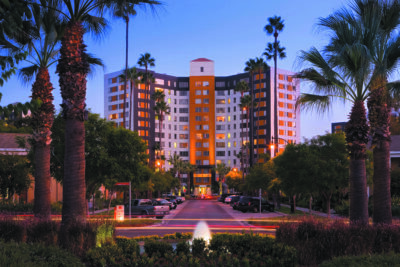
PARK LA BREA tower.
Park La Brea was one of Los Angeles’s largest and most unified responses to the mid-twentieth century housing crunch, offering different types of housing in one community. With the city again looking to greater densification as a solution to yet another housing crisis, I asked Dastoli if Park La Brea had any lessons to offer today’s planners and architects.
“Almost all the projects that I have been involved with have been for multi-family properties,” he told me. “Think of the grand apartment towers on Wilshire Boulevard, the charming courtyards in Los Feliz, the quaint duplexes in Citrus Square; these are all excellent examples of how density was achieved in early 20th century Los Angeles, while maintaining its feeling as a “City of Homes.” Park La Brea offers yet another version of well-designed density. Density is not difficult to do in the right way and in the right places. We should build a whole bunch more Park La Breas, but it can’t just be corrugated metal boxes with vinyl accents arranged around a strip of grass. The details matter. The massing, materials, window groupings, porch layout, all of this contributes to the sense of place at Park La Brea. By studying Park La Brea, local architects can quantify its feeling of community into objective design standards. This can be applied to high-density developments that provide the warmth and fulfillment of a true home, as opposed to the cold dissonance that we see too often with 21st century construction.”
If you would like to write a letter in support of Park La Brea’s nomination for Historic Cultural Monument designation, please send it to che@lacity.org.
Category: Real Estate