Limits of the Amsterdam model in Los Angeles
By Jon Vein
As Los Angeles continues debating the future of its transportation system, bicycle infrastructure has emerged as one of the most prominent issues in this year’s mayoral campaign. Advocates argue that expanding bike lanes and related policies can help reshape how Angelenos move around the city. Whether one agrees with that vision or not, the attention being devoted to the issue makes it worth examining a fundamental question: Is L.A. realistically capable of becoming the kind of bicycle-oriented city that advocates envision?
The question facing Los Angeles, however, is not whether bicycles are good. The question is whether transforming Los Angeles into a biking city is likely to succeed—and whether the costs imposed along the way will outweigh the benefits.
Before discussing bike lanes, “road diets” (the redesign strategy of L.A. Department of Transportation for L.A. streets), or comparisons to European cities, it is worth asking a basic question: What transportation problem are we trying to solve?
Most bicycle use falls into four categories. People ride bicycles to commute to work, to run errands and make purchases, to reduce their environmental footprint, or for recreation and exercise. The environmental benefits often cited by advocates are not really a separate use case. They are a hoped-for result. Lower emissions and less congestion occur only if enough people replace enough
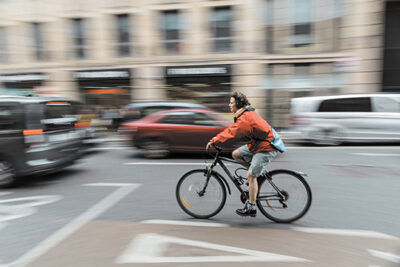
L.A. “ROAD DIETS” might need to rethink what the transportation problem really is in our city. Photo by Alessandro Santoro
automobile trips with bicycle trips. That means the real question is whether L.A. can realistically achieve bicycle adoption at a scale large enough to materially change transportation patterns.
That is where the case becomes much harder.
Consider commuting. In cities where bicycle commuting thrives, large numbers of people live relatively close to where they work. L.A. presents a different reality. Housing costs have pushed many residents farther from employment centers, not closer to them. Millions of Angelenos travel substantial distances every day because they cannot afford to live near their jobs. A bicycle may work for someone traveling a few miles. It is far less practical for the many workers commuting between the Valley and the Westside, Long Beach and downtown, Pasadena and Century City, or countless other long-distance trips that are routine in Southern California.
Errands present similar challenges. Bicycles are perfectly suitable for picking up a few groceries, visiting a coffee shop, or making a quick neighborhood trip. But most households regularly transport children, buy groceries for families, carry equipment, visit multiple destinations in a single outing, and make purchases that simply do not fit on a bicycle. For many residents, bicycles can supplement automobiles. They are unlikely to replace them.
That leaves recreation and exercise. Here there is little disagreement. Los Angeles already offers extensive opportunities for recreational riding, from the beach paths to Griffith Park, mountain roads, river paths, and numerous dedicated facilities. The question is whether a transportation system serving millions of residents should be substantially reconfigured to accommodate what, for many users, remains primarily a recreational activity.
Supporters of expanded bike infrastructure often respond with examples such as Amsterdam, Copenhagen, or Paris. They are correct to do so. These cities have achieved remarkable success in increasing bicycle use. But acknowledging that success is not the same as concluding that L.A. can replicate it.
Amsterdam occupies roughly 85 square miles. Paris covers approximately 41 square miles. Los Angeles spans nearly 470 square miles and sits at the center of a metropolitan region approaching 13 million residents. More importantly, L.A. County does not function around a single urban core. It operates as a network of major employment centers including downtown, Century City, Santa Monica, Burbank, Pasadena, Culver City, El Segundo, Long Beach, and many others.
Advocates often point out that parts of L.A. are as dense as parts of Paris. That is true. But transportation systems must be designed around how an entire city functions, not around a handful of neighborhoods. The challenge is not whether someone can ride a bicycle from Larchmont to a nearby coffee shop. The challenge is whether enough people can realistically replace enough automobile trips to justify transforming infrastructure on a citywide scale.
Another common response is that infrastructure changes behavior. People do not bike because the infrastructure does not exist; build it, and they will come. There is undoubtedly some truth to that argument. The question is whether infrastructure influences behavior enough. A substantial percentage increase in bicycle use may still represent a very small share of overall travel. Before removing travel lanes, parking, and loading zones, it is reasonable to ask whether the resulting increase in bicycle use will be large enough to justify the tradeoffs.
Supporters also frequently cite UCLA research suggesting that some road diets produce less congestion than traditional traffic models predict. However, the research examines whether specific corridors under specific conditions can be redesigned successfully. It does not conclude that all road diets are beneficial. It does not establish that parking reductions are harmless. It does not evaluate impacts on local businesses, deliveries, service vehicles, emergency access, or regional commuting patterns. Most importantly, it does not answer the broader question of whether enough residents will ultimately switch transportation modes to justify the costs.
Supporters of Measure Healthy Streets L.A., an approved citizen-led ballot measure that mandates safer infrastructure whenever L.A. performs street improvements, often argue that voters have already settled this debate. I disagree. HLA passed and is now the law, but passage of a ballot measure does not transform a policy into a proven success. California has a long history of adopting complex policies through initiatives, often based on compelling slogans and campaign messaging rather than detailed analysis of long-term consequences. Whether one agrees or disagrees with measures such as Proposition 13 (the limits on property taxes statewide in California), it is difficult to dispute that ballot initiatives can produce effects that are not fully understood at the time they are approved.
The proper response to HLA is continued scrutiny—not blind opposition, but certainly not blind acceptance either. Policymakers and residents should continue asking whether the assumptions underlying the measure are sound before irreversible changes are made.
Let me be clear: this is not an anti-bike argument. I support cycling. I support recreational riding. I support safer streets. I support targeted bike infrastructure where it makes practical sense. What I question is the assumption that L.A. can or should become Amsterdam simply because Amsterdam has succeeded.
Good public policy starts with an honest assessment of reality. L.A. is large, dispersed, expensive, and heavily dependent on regional mobility. Those realities may not fit neatly into the vision of a bicycle-centered city, but they are realities, nonetheless.
Before imposing significant costs on residents, businesses, commuters, and neighborhoods, we should have confidence that the promised benefits are achievable at meaningful scale in L.A. To date, that case has not been made.
The goal should not be to replicate another city’s transportation model. The goal should be to make Los Angeles work better for the people who actually live here.
Category: News