Future of Paramount: progress, pressure, Hollywood’s soul
By Jon Vein
For more than a century, the gates of Paramount Studios on Melrose Avenue have stood as both a literal and symbolic entrance to Hollywood. Behind them, generations of filmmakers built the mythology of the American film industry—long before “content” became a commodity and streaming platforms began reshaping the business.
Now, those gates may soon open to a very different future.
With the recent acquisition of Paramount by Skydance—and broader consolidation pressures across the entertainment industry—serious questions are emerging about the long-term fate of the 65-acre studio lot. While no final decisions have been announced, enough signals have surfaced to make one thing clear: the land itself is now as much a financial asset as it is a creative one.
And in Los Angeles today, that raises an unavoidable question: if not a studio, then what?
What’s actually likely
Despite the swirl of speculation, the most immediate future of the Paramount lot is not dramatic transformation—its continuity with subtle change.
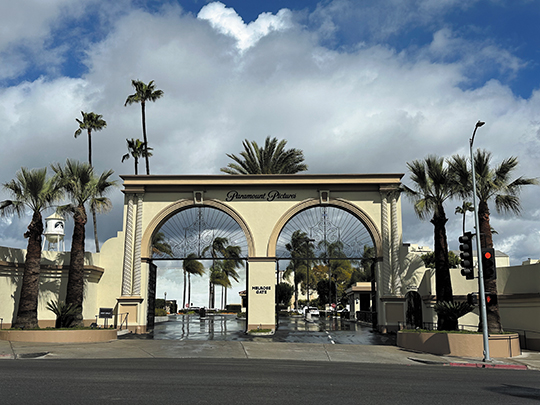
PARAMOUNT GATES on Melrose Avenue, a historic symbol of Hollywood’s Golden Age.
In the near term, the lot is expected to remain operational as a working studio. Leasing, in this context, largely means renting soundstages and production space to third-party film and television projects, a practice already common across Los Angeles. It’s a way to generate steady revenue without fundamentally altering the property.
But even that assumption—continued demand for large physical production space—no longer feels as certain as it once did.
The industry is already shifting. Production has been migrating to other states and countries for years, chasing tax incentives and lower costs. Now, emerging technologies, including AI-assisted production workflows, are beginning to reduce the need for some of the physical infrastructure that defined Hollywood for decades. Fewer large crews, more virtual environments, and increasingly flexible pipelines may gradually shrink the footprint required for certain types of content.
That doesn’t mean studio lots disappear. But it does suggest that the long-term demand for a 20th-century-style production campus may not fully translate into a 21st-century business model.
Which makes the future of the land itself all the more consequential.
The real estate reality
From a purely economic standpoint, the Paramount lot sits on extraordinarily valuable land. It occupies a central position in Hollywood, adjacent to transit corridors and surrounded by neighborhoods grappling with a severe housing shortage.
If even a portion of the site were rezoned for residential or mixed-use development, the numbers become significant very quickly.
At a moderate urban density—say 75 to 125 units per acre—a 65-acre site could theoretically support between 4,800 and 8,000 residential units. Even if only half the land were developed, that still translates to several thousand apartments, potentially including a meaningful share of below-market housing depending on city mandates.
In a city where affordability has become a defining political issue, that kind of capacity is hard to ignore.
And yet, numbers alone don’t tell the whole story.
The promise and the pressure of mixed use
The most realistic long-term scenario is not a wholesale conversion to housing, but a hybrid: a mixed-use campus combining residential units, retail, office space, and some form of retained production capability—though perhaps in a leaner, more modern form than what exists today. Think less traditional studio, more urban village—something not unlike The Grove, though on a larger and more layered scale.
Done well, this kind of development can bring real benefits. It can increase walkability, create local jobs, and activate streets that might otherwise go quiet after business hours. It can also align with Los Angeles’ broader push toward transit-oriented development and reduced car dependency.
But “done well” is doing a lot of work in that sentence.
Because developments of this scale also come with very real costs—especially during the years it takes to bring them to life.
The in-between years
Large mixed-use projects in Los Angeles typically take four to five years from entitlement to completion, sometimes longer. For neighbors, that timeline is not an abstraction—it’s a daily reality.
Construction traffic alone can reshape a neighborhood. Heavy trucks, lane closures, noise, and dust become part of the landscape. Local businesses often feel the strain as foot traffic becomes less predictable and access more difficult.
Even after completion, increased density brings its own challenges. More residents mean more cars—at least in the near term—placing additional pressure on already congested streets. While planners often point to walkability and transit as mitigating factors, behavioral change tends to lag behind design intent.
None of this is insurmountable. Thoughtful phasing, infrastructure investment, and traffic management can soften the impact. But they rarely eliminate it entirely.
A question of identity
Beyond economics and logistics, there is a deeper question at play: what does it mean for Los Angeles to lose—or transform—one of its last great studio lots?
The history here is not theoretical. Paramount traces its roots back to the silent film era. Its stages have hosted everything from Golden Age classics to modern blockbusters. The front gate alone is one of the most recognizable landmarks in the city.
Los Angeles has faced this kind of moment before—with mixed results.
The former May Company building on Wilshire Boulevard, now home to the Academy Museum of Motion Pictures, is often cited as a success story: a historic structure preserved and given new life with cultural relevance.By contrast, the demolition of the Dodge House in 1970 remains a cautionary tale—an architecturally significant property lost to development, replaced by something far less meaningful.
The difference, in many cases, comes down to intention. When preservation is treated as an asset rather than an obstacle, the results tend to endure.
What should be preserved
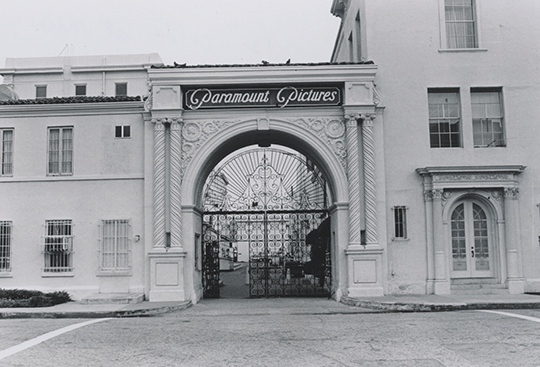
BRONSON gate that Charles Bronson got his stage name from.
If the Paramount lot does evolve, the question is not whether change will happen, but how much of its identity will survive.
At a minimum, certain elements feel non-negotiable: the Melrose gates, key soundstages, and portions of the backlot that carry historical and architectural significance. Integrating these into any future development is not just about nostalgia—it’s about continuity.
There is also an opportunity here, if approached creatively, to do something more ambitious: to build a model for how Los Angeles can honor its past while addressing its future.
The bigger picture
It would be easy to frame this as a binary choice: preserve the studio or build housing. But that frame misses the complexity of the moment.
Los Angeles needs housing. That’s not in dispute.
It also needs to retain the infrastructure—and the identity—that made it the entertainment capital of the world.
At the same time, the definition of that infrastructure is changing. If the industry itself requires less physical space, the argument for preserving every square foot of a traditional studio lot becomes harder to make—whether we like that reality or not.
The challenge is not choosing one over the other. It’s deciding what version of Hollywood we’re trying to preserve—and what we’re willing to let evolve.
A final thought
If the Paramount lot ultimately becomes something new—a mixed-use development, a residential hub, a hybrid campus—it will almost certainly be justified in the language of progress.
More housing. More efficiency. Better use of land. All of which may be true.
But progress, in Los Angeles, has a habit of erasing the very things that made the city worth progressing in the first place.
So, the real question isn’t what will be built on that land. It’s whether, years from now, anyone will still recognize what used to stand there—and whether we’ll feel like we traded up, or simply traded away.
Category: News