A hospital in transition becomes an immersive art exhibition
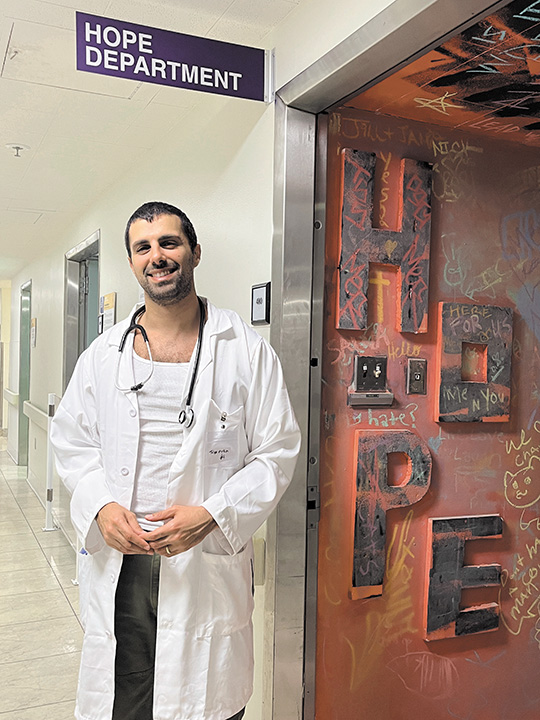
HOSPITAL OF EMOTIONS organizer Oshri Elmorich stands in the Hope Department.
Colorful creatures, glowing tubes, and a roomful of polka dots are just a few of the tableaux visitors will see in a new exhibit in the abandoned St. Vincent Medical Center. The hospital closed in January 2020 but is scheduled to become a behavioral health center by 2028, with services for those with mental health concerns, addiction, and housing insecurity. In the interim, a group of artist entrepreneurs breathed new life and meaning into the closed hospital’s deserted patient rooms, imaging facilities, and surgical suites by creating the Hospital of Emotions. Oshri Elmorich, one of the organizers along with House of Art & Dreams, which specializes in turning vacant spaces into site-specific installations, wanted the hospital space to have a universally appealing theme. And what’s more universal than an exploration of our feelings, especially when explored in a space as fraught as a hospital setting. “It’s 40,000 square feet of emotional baggage,” he explained.
The exhibit has resonated with visitors, attracting arts aficionados, families with young children, medical professionals, and veterans who reported surprise at the depth of emotion the installations evoked.
Organizers leaned into the hospital theme. Visitors are admitted and outfitted with a patient ID wristband before entering the exhibit. Docents wear hospital whites. A “pharmacy” is a vending machine outfitted with water bottles labeled such things as “self-esteem upgrade,” “confidence refill,” and “healthy boundaries.” There’s a florist selling brightly colored fake flowers and a gift shop with T-shirts, totes, and books with emotional health themes. Stairwells feature posters with real information for those needing mental health help.
Eighty rooms over four floors of the empty facility were divided into eight emotion-laden departments: resilience, joy, love, fear, anger, hope, sadness, gratitude, and compassion. Seventy artists were each given a $4,000 stipend, up to $10,000 for supplies, and two weeks to complete their vision.
Room installations vary widely, from cartoon monsters to enchanting forests. Many are behind protective plexiglass, but some allow visitors entrance into their environments for a more immersive experience. Each artist’s vision statement is hung by their decorated room, giving valuable insight into their process.
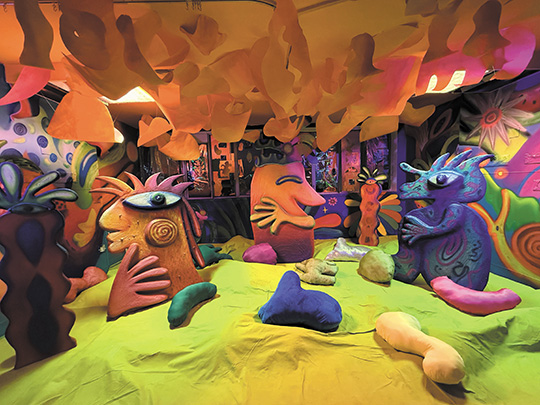
COLORFUL CREATURES by Mariell Guzman represents how a joyful imagination can overcome the loneliness and displacement felt by an immigrant.
For example, in the Hope Department, a felled log is attached to intravenous drip bags filled with moss, seed pods, and other bits of nature. Artist Michelle Lougee’s statement asserts that the collapsed community member is receiving life support, reminding us that community working together is our only hope of healing our environment. Javiera Estrada’s room-sized Twister game played by colorful floppy dolls represents the joy of human interaction. Kim Farbota’s eerie room is a tangled web of white glowing tubes that emerge from a hole in a hospital bed, conjuring an ineluctable feeling of sadness. Farbota explained that “The web suggests an interconnection that passes though us even when we feel most hollow. … To feel sadness is to know what we hold dear.”
Interactive installations are particularly successful. In a room by House of Art & Dreams, we are asked to write something for which we are grateful on a sticky note, and over time the space became wallpapered in fluttering pink, orange, and yellow papers that give thanks for “family,” “god,” “soup,” and “the divorce lawyer.” In a particularly moving installation for the emotion of anger, a hospital bed is surrounded by piles of upended chairs, books, papers, and broken records. A chair faces the ramshackle scene. Ray Karam’s statement explained that he was angry when he lost his uncle and wanted to yell and scream but held it together to be strong for his family. The chaotic piles represent Karam’s memories of his uncle. He invites us to sit in the chair and recognize how we may have dealt with loss.
A portion of the ticket proceeds will support the St. Vincent Behavioral Health Campus.
The Hospital of Emotions at St. Vincent Medical Center; 2131 W. 3rd St.; hospitalofemotions.com. The exhibition is open through the end of September. Tickets are $58, with discounts for children, students, seniors, and veterans.
Category: Entertainment