


Quintessential L.A. architect shines in exhibits at LACMA, USC, and Getty
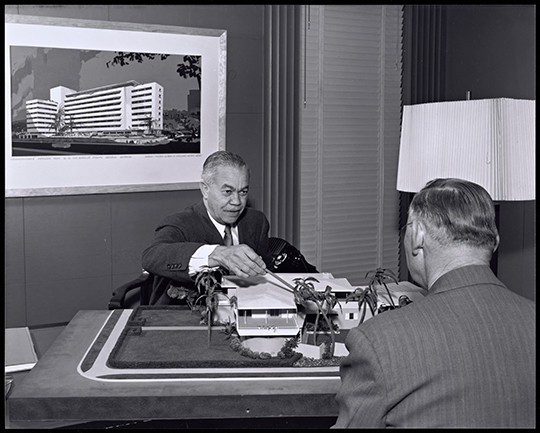
PORTRAIT OF PAUL WILLIAMS, at LACMA. By Julius Shulman
By Helene Seifer
Groundbreaking architect Paul R. Williams (1894—1980), a native son of Los Angeles, began his career designing homes, religious institutions, and commercial buildings in the 1910s. At the time of his death, he had designed over 3,000 projects and was instrumental in defining the built landscape of Los Angeles, as well as in creating seminal structures in other American cities and in Latin America. The first Black architect licensed west of the Mississippi and the first to become a member of the American Institute of Architects, Williams was posthumously awarded an AIA Gold Medal in 2017, their highest honor.
His considerable accomplishments are examined in three coordinated exhibits: “Paul R. Williams: Architect for Living,” at LACMA through Sun., May 23, 2027; “Paul R. Williams: An Architect Considered,” at USC Fisher Museum of Art through Sat., March 13, 2027; and “Paul R. Williams: Architecture Across the Color Line,” at the Getty Research Institute from Tue., Dec. 15, 2026 through Sun., July 18, 2027. Many of the works on display are never-before-seen photographs and drawings from his archives, which were acquired by USC School of Architecture and the Getty Research Institute.
Williams had a deep commitment to inclusion, as evidenced by his work with the Black community through designing low-cost housing in Compton and building the First African Methodist Episcopal Church of Los Angeles. He hired a diverse group of architects for his firm, and his work was exceedingly varied, from luxury hotels and palatial mansions to schools, apartment buildings, and hospitals. He designed the Polo Lounge and Crystal Ballroom at the Beverly Hills Hotel, Saks Fifth Avenue in Beverly Hills, and, as part of a collaborative team, the Theme Building at LAX.
Architect to the stars
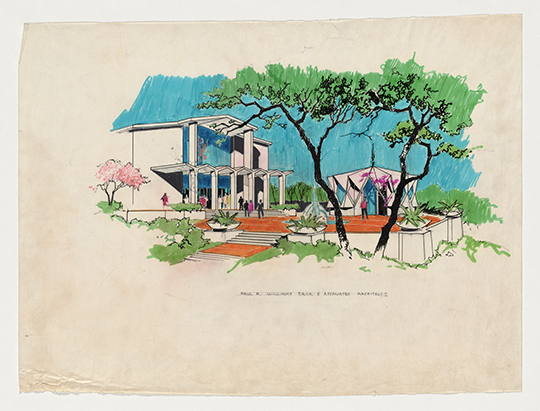
FIRST AFRICAN METHODIST Episcopal Church of Los Angeles (exterior rendering), ca. 1960, by Paul R. Williams. From the Getty Research Institute exhibit.
Jointly owned by the Getty Research Institute and the USC School of Architecture. © Della M. Williams Trust
Despite his range, he is often described as an architect to the stars. Williams was much in demand by the wealthy and celebrity set, who appreciated his penchant for expansive, curved stairways, large patios that extended the living room, and modern touches, such as retractable window screens and built-in cabinetry. Clients included Frank Sinatra, Lucille Ball, and Cary Grant. Denzel Washington, Ellen DeGeneres, and Andy Garcia were among those who later purchased a Williams home. One of the many homes in the Hancock Park area that the architect designed is currently the residence of the Consul General of Mexico.
Williams’ embrace by wealthy clients is remarkable because, for most of his life, he would not have been allowed to live in the neighborhoods where his grand homes were built; redlining barred African Americans from residing in those enclaves. In fact, Williams is famously known for developing an ability to sketch upside down, so white clients wouldn’t have to sit beside him while he drew ideas for their homes; instead, they could comfortably sit on the opposite side of the table and still see their projects take shape in the correct orientation.
The three exhibits each focus on specific aspects of Williams’ life and career. Williams’ love of sweeping staircases is used as a unifying design element at LACMA, with stair-like display cases and furniture, and the architect’s color palette is used to ground the displays. Over 120 items from his archives form the backbone of the exhibit, along with additional photographs and objects, such as his piano, which was a recent gift to the museum. Visitors will be immersed in Williams’ world, from his architecture office to projections that convey the grand scale of much of his work. The USC Fisher Museum of Art exhibit centers on Williams’ designs for dignified, innovative, multifamily housing; 35 of his projects from the U.S.’s period of rapid growth and urbanization are featured. The Getty Research Institute concentrates on the architect’s impact in the Black community, showing how design was able to contribute to hope and community at a time when opportunities were limited.
LACMA; 5905 Wilshire Blvd.; lacma.org. Included with general admission tickets, $25. USC Fisher Museum of Art; 823 W. Exposition Blvd. (on USC campus); fisher.usc.edu. Free. Getty Research Institute, at the Getty Center; 1200 Getty Center Dr., Suite 1100; getty.edu/research-institute. Free admission; paid parking.
Category: Entertainment
