Earth Day 2026: Saving fish, Marlborough program, eco fashion
Earth Day falls on April 22. Founded in 1970 by U.S. Sen. Gaylord Nelson, it marked the start of the modern environmental movement, raising awareness and leading to the formation of the Environmental Protection Agency the same year.
This issue the Chronicle looks at a few individuals for whom everyday is Earth Day and who involve themselves in environmentally conscious activities, businesses, and education.
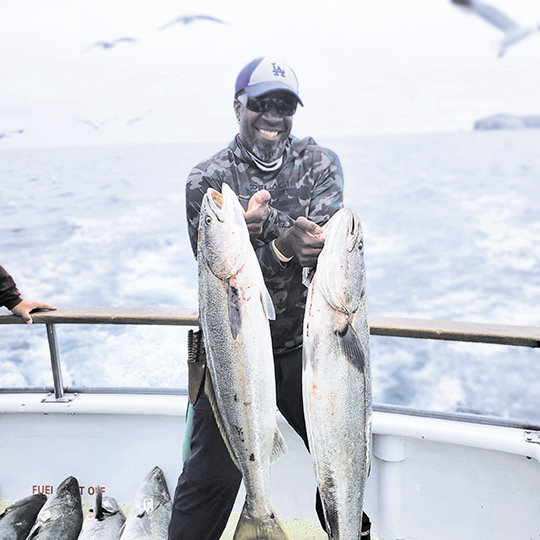
63-POUND white seabasses and Torin Anderson on the Betty O’ sports fishing boat.
Program helps repopulate the Pacific
By H Hutcheson
Torin Anderson of Leimert Park loves to fish. “It’s the closest thing I know that can slow time down. It keeps me sane—or halfway sane!” He made the choice to ease out of corporate life and spend more time in the “reel world,” where he is on the board of directors of both Marina Del Rey Anglers Fishing Club and the South L.A. Chapter of the Costal Conservation Association. He even works at Sav-on Tackle in Santa Fe Springs—the 74-year-old business is one of the oldest and biggest tackle shops in L.A.—to be close to his passion.
On a kayak, a charter boat, on shore or off, lakes, oceans, rivers—any sort of fishing—Anderson is your man. His favorite fish to catch are white seabass from the Pacific Ocean around the Channel Islands. Overfished by commercial fishermen, they suffered historic population lows in the late 1900s, which prompted Hubbs Seaworld Research Institute to work on repopulating the ocean with the species through aqua-culture support. That is where Anderson decided he could make a difference.
For more than eight years he has volunteered with the group Pen Pals through MDRA and in partnership with CCA and Hubbs to support the population of his favorite fish. “I give back so I can keep having fun,” he said.
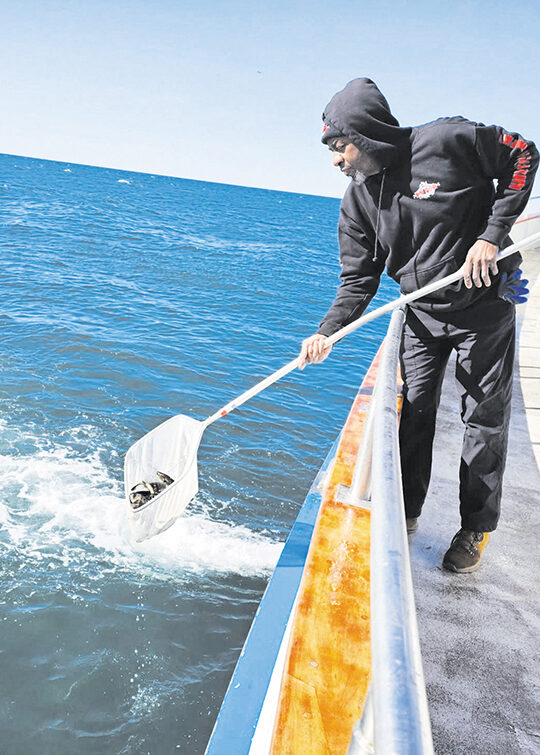
SUSTAINABLE FISHERY helps once-endangered fish.
“The fish arrive to us in October at about three inches long. My jobs include feeding them and doing maintenance on the pens. As volunteers we also do a good deal of recording growth, water temperature, and deaths of any fish who are finally chipped for research. Release day was early this year, March 5, because of their unusually fast growth in 2026. They were crowded into a pen and transferred to a bait tank on the sports fishing boat, the Betty O (which is over 100 years old and happens to be the same boat we will fish from later!). We successfully sent out 1,458 white seabass. That night, at the dock, we released more from the containment gates without predation as we shielded them from hungry sea lions. They swam out to populate the Pacific.”
A report in 2022 that involved Hubbs and the South Carolina Department of Natural Resources said that white seabass from Southern California release programs are a huge success environmentally with 30 percent of wild caught adult fish being from the hatchery. “Conservation is key,” said Anderson. “We have to give back in order to continue to receive.” Fair winds, Mr. Anderson!
Earth Day benefts through local student
By H Hutcheson
Another “planet hero” on this Earth Day is local student Avery Sangster, a student at Marlborough Hancock Park’s oldest all-girls, college-preparatory private school. Among its many academic departments, the high school offers The Leonetti/O’Connell Honors Research in Science program headed by Allison Ponzio, Ph.D., which Sangster is part of.

AVERY SANGSTER is a student in the Leonetti/O’Connell Honors Research in Science Program at Marlborough.
Ponzio explained, “The program offers students the opportunity to participate in hands-on research in a STEM+ subject for which they have an inherent passion. Students conduct their research projects in an academic laboratory setting or collect data on campus for one to two years, receiving guidance and supervision from a professional research mentor and Marlborough faculty, which results in deep, meaningful scholarship.”
I asked Sangster to tell us more:
Earth Day is coming up in April. Are you doing research that you think pertains?
I am a senior and in my second year of the Marlborough Honors Research Program. I work in a wet lab at the UCLA Institute of Carbon Management, where I assist graduate students with research focused on carbon capture. Carbon capture is the process of removing carbon dioxide (CO₂) from the air or emissions and storing it so it can’t enter the atmosphere, which is important because it helps reduce the greenhouse gases that contribute to climate change.
Tell us about your project.
In my first year, I assisted on a low-carbon cement project researching a scalable method to produce a cement alternative that could reduce emissions from traditional cement production. This is an important challenge, as the cement industry would rank as the third or fourth largest emitter of CO₂ if it were a country. This year, I am working on a seawater carbonation project that focuses on accelerating the ocean’s inherent ability to absorb and permanently store massive amounts of carbon.
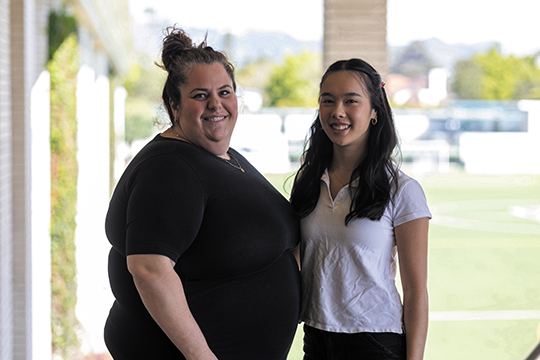
REAL-WORLD RESEARCH has inspired Avery Sangster (right), pictured with Honors Research Program Head Dr. Allison Ponzio.
What do you hope to study when you leave Marlborough?
I plan to study engineering at the University of Michigan this fall. My time at the lab has certainly inspired me to love chemical engineering, especially its intersection with sustainability; however, I’m open to exploring other engineering disciplines. I love science and math, and research allows me to not only apply the concepts I learn in school, but also to be hands-on in finding solutions to real-world challenges.
Tell me about yourself!
I live in Hollywood Hills but grew up eating Sam’s Bagels and going to the Larchmont Fair. I have always been passionate about fighting climate change and co-authored “COOL: Women Leaders Reversing Global Warming,” the first book to document the work of women climate leaders globally. I also love to play tennis and bake for my friends and family.
Clothing honors Earth Day (and L.A. style)
By Barbara Sueko McGuire
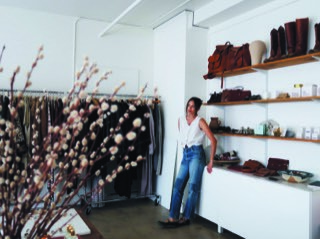
SARA RUHE at her shop, Barnaby Jack.
When Sara Ruhe started thrifting as a teenager in Tucson, Arizona—mostly as a way to escape the summer heat—she never imagined that years later it would grow into a meaningful career. What began as a small collection of thrifted tees and accessories eventually evolved into Barnaby Jack, a curated vintage boutique featuring easy-to-wear items from across the decades. Now based in the Larchmont area, Ruhe runs the business primarily through her website while raising her young son with her husband.
“It’s actually really fascinating as a vintage seller to see the history of fashion when I’m sourcing and how materials and construction have changed over time,” she said. “You get to see pieces from the Edwardian era that are still wearable to this day—we are talking over 100 years old. Then synthetic fabrics were created, and you can see a slow downhill from there.”
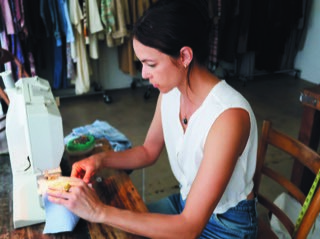
SUSTAINABLE HIERARCHY “Reduce, Reuse, Recycle,” is something Ruhe lives by with her clothing business.
Downhill indeed. The fast fashion industry is not only churning out items that barely withstand a single wear but also contribute heavily to environmental damage. From 2021 to 2024, Californians sent roughly 9.6 billion pounds of clothing to the landfill, according to estimates. Often, what is optimistically “donated” ends up trashed, incinerated, or dumped overseas.
Worldwide, the fashion industry produces more than 92 million tons of textile waste each year and accounts for about 10% of annual carbon emissions—more than international aviation and shipping combined. Choosing used clothing can significantly reduce that environmental impact, with some resale research suggesting that buying used can cut a garment’s carbon footprint by around 80%. And while it’s possible to buy new clothing that’s ethically and sustainably produced, choosing secondhand is the greenest way to shop and take a step back from the mass production cycle.
“The fast fashion industry is one of the top polluters in the world,” explains Ruhe. “The process of making clothing is incredibly harmful to the planet: it’s the second biggest consumer of water often requires toxic dyeing processes, not to mention the underpaid and inhumane work environments for people all around the world.”
While sustainability may lead some shoppers to explore vintage, Ruhe says that it’s also just a fun and often more affordable way to approach fashion and personal style. Getting started is easy—the first step is figuring out your budget and how much time you have available for the hunt. Thrift stores can offer great finds for those willing to search, while local flea markets, antique fairs, and vintage stores provide more curated and styled selections. Regardless of where people begin, the key is shopping thoughtfully and choosing pieces meant to last.
“Everything is one-of-a-kind and so it’s inherently special,” says Ruhe. “If something speaks to you, it’s more than just an article of clothing, it’s a tool to express your unique style, your voice. That is something fast fashion has a hard time providing.”
Barnaby Jack sells vintage clothing online at shopbarnabyjack.com, with by-appointment studio visits available in downtown Los Angeles.
Category: People