Miracle Mile to be connected by rail for first time in 79 years
By Jack Brownlee
Two new Metro subway stations will be opening along Wilshire Boulevard in the coming months as Metro completes Phase One of its D Line Extension project. Both located in Miracle Mile, stations at Wilshire/La Brea and Wilshire/Fairfax will allow better, more reliable transit for the roughly 65,000 people living within the surrounding mile. Alongside these two will be the opening of another station located in Beverly Hills at Wilshire/La Cienega.
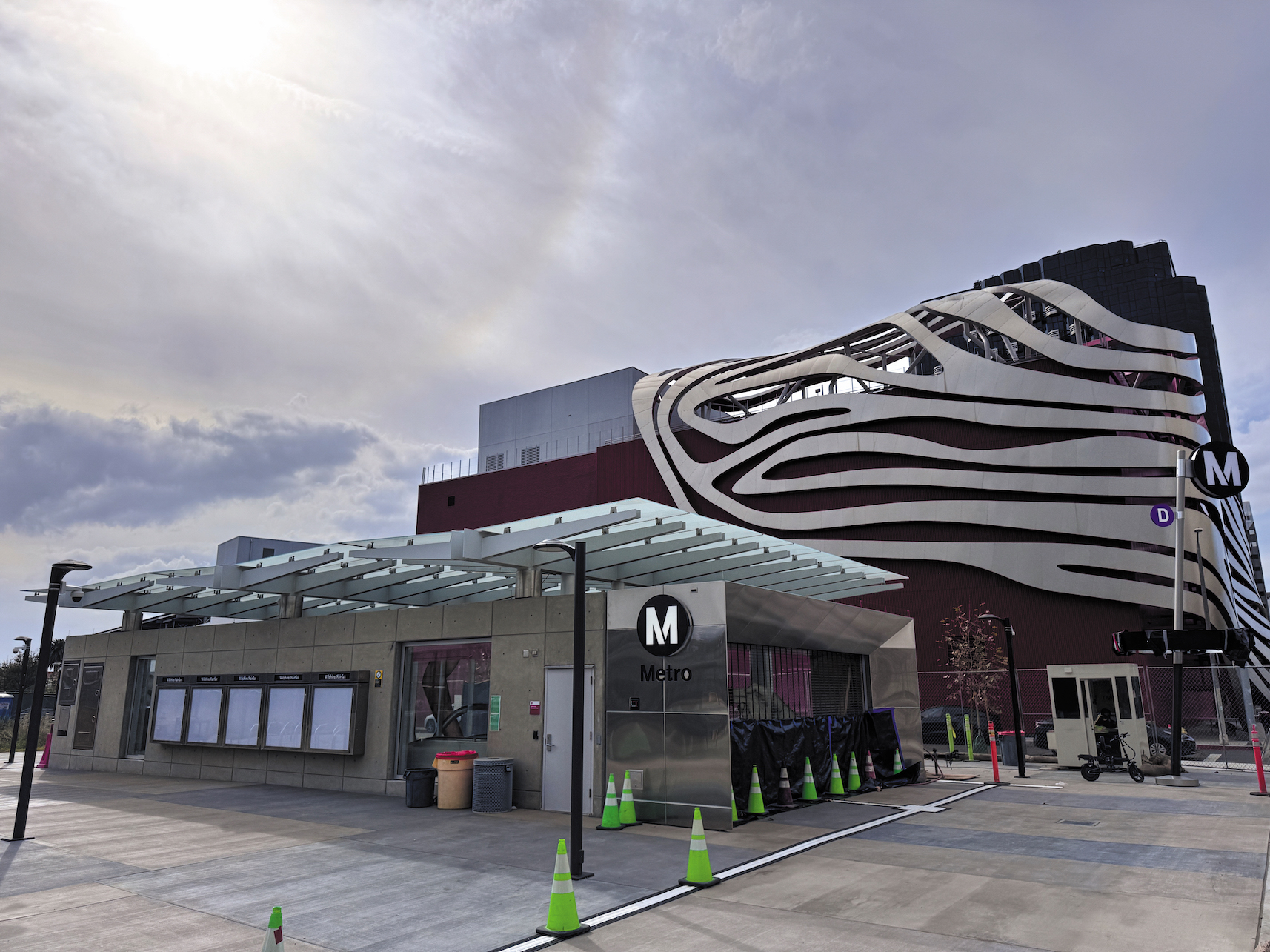
WILSHIRE/FAIRFAX STATION is opening this spring.
Not since the old Red Car electric trams drove the streets of Los Angeles has Miracle Mile had a rail station. Los Angeles used to have more electric railcars than any city in the world, but after World War II the city shifted away from transit and began investing in its extensive freeway system. Pacific Electric discontinued Red Car tram service to Miracle Mile in 1947.
On February 26th, Metro announced the new stations would be opening on May 8th. A ceremony is expected to be held to celebrate the openings. Service testing of the trains began in mid-February.
The creation of these subway stops is just one part of a massive underground transit project Metro has been working on for decades. The project seeks to extend Metro’s D Line (formerly the Purple Line) subway from Koreatown to Westwood. In the coming years L.A. will see the completion of Phase Two, which establishes stops near Rodeo Drive and Century City, and finally Phase Three, which creates stations at UCLA and the Westwood V.A. Hospital. When the project is finished riders will be able to go from downtown to Westwood in 25 minutes.
After nearly 20 years of planning, legal battles, and public forums, Metro officially broke ground on the project in 2014. Initially the Phase One stations were projected to open in November 2023. The current opening forecast is nearly 900 days late.
One major reason for the delays, not to mention cost increases, has been opposition from the City of Beverly Hills. While most Angelenos are glad to see the expansion of public transit, residents and politicians in Beverly Hills have filed several lawsuits in the past two decades against Metro claiming that the extension project endangers residents. Some have hoped that President Trump, who has owned several properties in the city, could get the project rerouted or postponed. Despite the city’s efforts, Phase One of the Extension will continue.
Both stations will feature artwork by award-winning L.A.-based artists. Extensive landscaping and beautification efforts have been realized, extending beyond the stations themselves and into the immediate surroundings. New medians and safety measures on Wilshire near each station were added to ensure that riders feel comfortable taking the new line.
The final cost of Phase One is $3.5 billion. The majority of funds came from federal grants and loans, and about $800 million came from Measure R taxes. Measure R adds 0.5% sales tax in Los Angeles County, and revenue goes directly to transportation measures like rail projects and highway improvements. It was passed by a two-thirds majority of voters in 2008.
Category: News