L.A. is fighting homelessness backward—the math matters
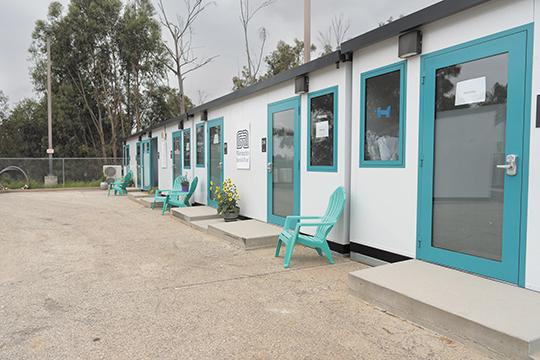
HOUSING built by DignityMoves in Thousand Oaks.
By Jon Vein
Los Angeles is trying to solve a 75,000-person crisis with $700,000 apartments—and it isn’t working.
Tens of thousands of people remain on the streets while the city spends years building a relatively small number of extremely expensive housing units. The issue is not a lack of effort. It is a mismatch between the scale of the crisis and the strategy being used to address it.
If Los Angeles had unlimited resources, the solution would be straightforward. The city could invest heavily in prevention, build large amounts of long-term affordable housing, expand permanent supportive housing for those who are elderly or severely disabled, fund treatment and recovery programs, and create enough interim housing so that no one ever had to live on the street.
That is the full toolkit—and all of it matters. But Los Angeles does not have unlimited resources. And when resources are limited, the math matters. Priorities matter. Timing matters.
For years, the city’s approach has leaned heavily toward the slowest and most expensive intervention: permanent supportive housing for people who have already spent months or years on the street. These projects often cost $600,000, $700,000, or even more than $800,000 per unit—and can take three to six years to deliver.
Meanwhile, roughly 75,000 people in Los Angeles County—including about 44,000 in the city—are experiencing homelessness. Most are unsheltered, living on sidewalks, in vehicles, or in encampments.
Against numbers like these, a strategy centered primarily on extremely expensive housing cannot possibly scale to match the crisis.
Los Angeles, in effect, has been attacking homelessness from the wrong end. The real leverage point is not the end of the pipeline. It is the beginning.
Most people do not initially become homeless because they suffer from severe disability or long-term addiction. The best available data suggests that only about 15% to 20% of people have serious mental health or substance use issues when they first lose housing. For many, the initial cause is far more ordinary—a financial shock, a lost job, a medical bill, a family conflict, or simply the inability to keep up with rising rents.
If they are helped early—through modest rent subsidies or rapid placement into inexpensive housing—the cost to stabilize them can be relatively modest, often in the range of $10,000 to $50,000. With the right support, including job training and basic services, many can return to work, reconnect with family, and reenter the mainstream of society within months.
But if they are not helped quickly, everything changes. Street homelessness is not just a housing problem. It is a process—and it accelerates over time.
The longer someone remains outside, the more likely that a housing crisis turns into a behavioral health crisis. Addiction rises. Mental health deteriorates. Physical health declines. Trauma accumulates.
Within months, the numbers begin to flip. What may start with roughly 15% to 20% of people struggling with serious behavioral health issues can rise dramatically—in some cases to 70% or more among those experiencing prolonged homelessness. In other words, homelessness itself makes people sicker.
At that point, the system is not paying once—it is paying continuously. Public costs begin to stack up: emergency rooms, hospital stays, law enforcement, sanitation, and ongoing support services. Those costs can easily exceed $100,000 per person per year when all factors are considered. And unlike early interventions that resolve homelessness in months, these costs often continue for years.
That is the real difference. It is not simply that early intervention is cheaper. It is that delay turns a short-term, solvable problem into a long-term, compounding one—both financially and humanly. This is why the first months of homelessness matter so much.
There is also a common misconception that many people experiencing homelessness prefer to live on the streets. While a small minority may resist housing, the reality is more nuanced.
Most people want housing. What many reject is congregate shelter—large rooms filled with bunk beds, little privacy, and environments where one unstable or disruptive individual can affect everyone else. For many, the privacy of even a tent can feel safer and more manageable than those conditions. This is where interim housing becomes essential.
One model worth paying attention to is the community-based approach used by organizations like DignityMoves. This is not about putting up rows of flimsy structures. These are intentionally designed communities with private rooms, shared dining and gathering spaces, showers, and on-site services.
When people are living on the street, they are dispersed and difficult to reach. Delivering consistent services—whether mental health care, addiction treatment, or job training—becomes extremely challenging.
But when people are in a defined community, everything changes. Providers know where they are. Services can be delivered consistently. Job training, treatment, and support can take hold. People have a real chance to stabilize and move forward.
These communities can be built quickly and at a fraction of the cost of permanent supportive housing. Including services, the cost can be on the order of $40,000 per person per year—far less than the societal cost of allowing someone to remain on the street.
Other regions have begun to adopt this approach at meaningful scale. Los Angeles, despite the size of its crisis, has not.
Instead, the city continues to rely heavily on a model that produces a relatively small number of extremely expensive units over long periods of time—while tens of thousands of people remain outside waiting.
Homelessness is not only a humanitarian issue. It is also bad for safety, bad for neighborhoods, bad for small businesses, and bad for the overall health of the city.
Los Angeles does not need to choose between compassion and fiscal responsibility. In this case, they are the same thing.
Jon Vein is a co-founder and board member of DignityMoves.
Category: News