DATALAND: New museum of AI arts asks, ‘Can artwork feel us?’
By Helene Seifer
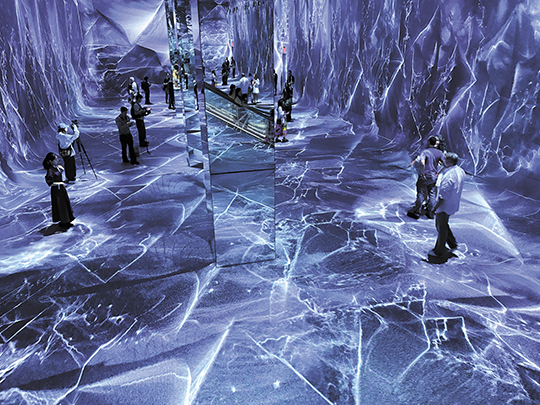
DAZZLING AI ART surrounds visitors in DATALAND’s “Machine Dreams: Rainforest.” Photo courtesy Zach Grossman
At DATALAND, the new downtown museum for AI arts, a gleaming escalator carries visitors into the heart of its inaugural exhibit, “Machine Dreams: Rainforest”—and the descent is breathtaking. Dazzling floor-to-ceiling projections in the cavernous room display seemingly 3D trees, flowers, and swirling organic and geometric designs. More than 10 million lines of code were needed to build an interactive environment where people become part of the AI machine—walk, and dappled leaves follow; wave an arm, and a profusion of flowers floats aside. Museum guests each don an electronic wristband that measures the wearer’s heart rate, temperature, and movements. A neck device releases individually tailored scents and sounds of the rainforest. Wall text identifies the gallery as “a living environment where structure, image, sound, scent, and human presence become part of a single responsive system.” This Big Brother intrusion is meant to enhance the museum experience, but guests can choose to opt out.
UCLA-educated media artist Refik Anadol, who teaches at his alma mater, and Efsun Erkiliç are the Turkish-born married co-founders of Refik Anadol Studio and creators of DATALAND. The duo was inspired by the powerful connection to nature they felt when visiting the Amazon rainforest and decided to create an immersive space that would inspire others as deeply. A leader in the rapidly growing AI space, the Frogtown-based studio has been developing smart machines and reactive spaces to generate everything from the constantly changing AI art wall featured in the lobby of the Museum of Modern Art in New York to a system titled Large Nature Model. It’s the first open-source generative model that collects data on the natural world in real time and serves both as the basis of information for DATALAND’s exhibits and as a modern, living encyclopedia.
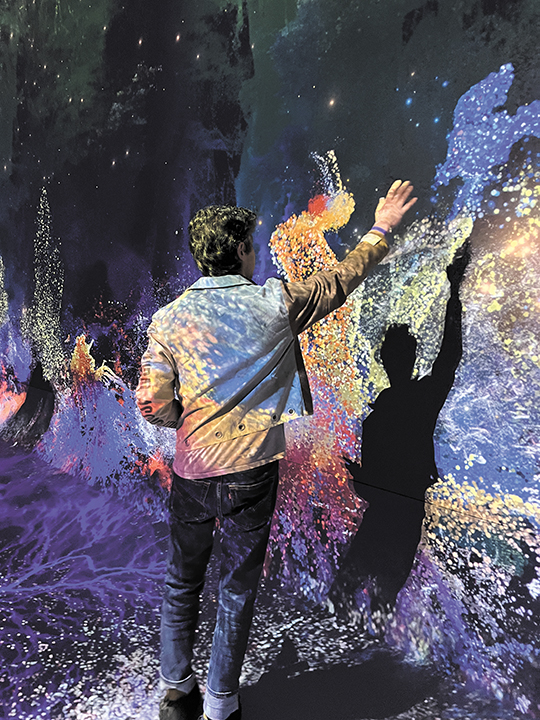
A VISITOR’S MOTION affects the trajectory of the projections in the exhibit.
Drawing upon facts sourced from such institutions as the Smithsonian, the Cornell Lab of Ornithology, iNaturalist, and London’s Natural History Museum, the studio also collects data from sensors installed in 16 rainforests: the rate of water absorption of different trees, changing temperatures, forest sounds, and smells. “Our data sets are recognized by the U.N. as one of the largest ethical data sets,” Anadol said. The continuously collected data informs the exhibit, and the exhibit, in turn, is meant to inform the public, although intellectually the relationship is tenuous. Mainly it’s magical to be engulfed by dynamic visuals, scents, and sounds.
“Machine Dreams: Rainforest” is presented across 25,000 square feet of gallery space, with another 10,000 square feet housing the technology systems, which process the Large Nature Model’s 1.2 billion bits of constantly updating information. One gallery has a station where visitors can explore the Large Nature Model for statistics and images of flora, fauna, and our environment. Other stations allow visitors to generate artwork with their movements or by drawing on a touchscreen, which is electronically translated into an image of a flower or fungus.
Another gallery more directly touches on the precariousness of nature. A translucent hummingbird embodies the hope of nature’s continuity as it flies through a lush environment that will never exist again. Among other sounds recorded in the rainforest is the actual last-known plaintive call of a now-extinct Hawaiian bird, serving to remind us of the perils of ecological extinction.
The last gallery aggregates the wristband data from each person in the museum that day and generates a visual and sonic experience that purports to be based on that group’s temperatures, heart rates, and movements. A lush, roiling red and green sea was produced the day I visited. It wasn’t clear what that said about us.
“We are creating art to touch the mind and soul of our audience,” Anadol summarized during a media presentation for DATALAND. “For thousands of years when we look at artwork, we feel something. Can artwork feel us back?”
“Machine Dreams: Rainforest,” at DATALAND; 100 S. Grand Ave., in The Grand Hotel; dataland.art. Adult tickets $49-79. Different rainforests will be featured throughout 2026.
Category: Entertainment