Anti-camping zones to be removed across CD13
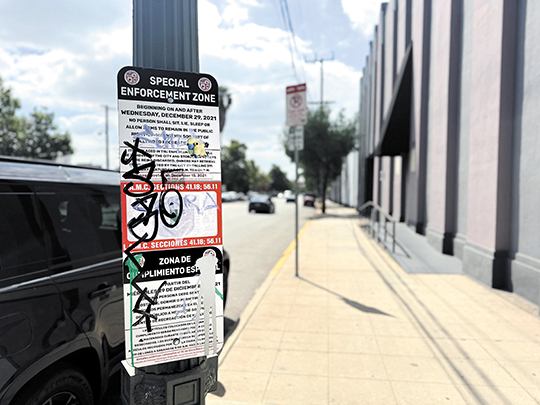
ANTI-CAMPING SIGNS will be coming down in parts of CD13.
By Jack Brownlee
Twelve anti-camping zones will soon be removed across Los Angeles City Council District 13 after a motion put forth by Councilmember Hugo Soto-Martínez was approved by a 10-3 vote. Soto-Martínez stated this is the first time the City Council has voted to remove anti-camping zones rather than create new ones. The zones to be removed include those near Barnsdall Art Park, Sunset Junction, the Las Palmas Senior Center, and several intersections in the Silver Lake and Echo Park neighborhoods. Soto-Martínez’s office clarified that anti-camping zones around schools and day care centers will still be strictly enforced, and that camping in public parks continues to be illegal under a separate law.
The City Council establishes these zones using Section 41.18 of L.A.’s Municipal Code, a controversial statute that was first enacted in 1963 and later amended in 2021. The zones prohibit anyone from sitting, sleeping, lying, or storing property on streets, sidewalks, and footpaths. Violators are charged with a misdemeanor, which comes with fines up to $2,500 and/or jail time of up to 6 months.
“Displacing our neighbors from block to block, or in many cases, from district to district, doesn’t help them find housing,” said Soto-Martínez. “In fact, in most cases, it makes it much harder for us to help them, because they lose their belongings, they get fined, and many times they are arrested.”
Three councilmembers voted against Soto-Martínez’s motion, and several more strongly defended the use of 41.18 in their respective districts. One of the dissenting votes came from Councilmember Monica Rodriguez, who said “41.18 was never intended to be the solution to our homeless problem. In fact, quite the opposite. It’s just about protecting public spaces for families who want to be able to take their kids to the park.”
A little history
Section 41.18 was first introduced in 1963 as an amendment to a previous anti-loitering law. Conservative Angelenos praised the law, which was “aimed at keeping the Hippie type of elements” at bay, according to journalist Jim Newsom of the Hollywood Citizen-News. Violators “would not be cited but would be arrested.” Over the past few decades, however, Los Angeles has seen a major increase in homelessness, and police have used 41.18 to more strictly fine and arrest people in homeless encampments that block public rights-of-way.
In 2006, a U.S. Court of Appeals ruling, Jones v. City of Los Angeles, found that 41.18 violated the Constitution’s Eighth Amendment, which protects against cruel and unusual punishment. It was deemed unconstitutional on the grounds that “involuntary sitting, lying, or sleeping on public sidewalks [is] an unavoidable consequence of being human and homeless without shelter in the City of Los Angeles,” and therefore 41.18 punishes status rather than conduct. The City ended up settling, and L.A. was prohibited from enforcing 41.18 until it built 1,250 new shelter beds.
However, 41.18 was again declared unconstitutional after the 2018 federal ruling Martin v. Boise, which ruled that “an ordinance violates the Eighth Amendment insofar as it imposes criminal sanctions against homeless individuals for sleeping outdoors, on public property, when no shelter is available to them.” L.A. was again unable to enforce 41.18 until 2021, when it amended the law. “The constitutionality of the current version of 41.18 is still disputed,” according to the City Controller’s website.
A 2024 memo released by City Council made headlines after it was found that L.A. had spent $3 million on enforcement of 41.18 over three years, yet only two unhoused people had successfully found permanent housing after being “engaged during Ordinance enforcement” in that span. The memo also stated that a whopping 81% of encampments which were “swept” by 41.18 enforcement were repopulated.
Public opinion on Soto-Martínez’s decision is split. The tumultuous history of 41.18 played a large role in Soto-Martínez’s decision to remove the anti-camping zones, and his actions are being lauded by people experiencing homelessness and those working closely alongside them. Many see the resources being devoted to 41.18 as inefficient, and by rerouting them elsewhere, better care can be given to unhoused individuals.
Many CD13 residents, however, have been quite vocal about their disapproval for the measures. There has been criticism of Soto-Martínez’s decision against holding more public discussion prior to filing the motion. Some people feel that encampments make streets and sidewalks feel unsafe, causing public unease. The Chronicle has received multiple letters about CD13’s removal of anti-camping zones, some of which are included in this issue.
The zones in CD13 will be eliminated once the physical signs designating the areas are removed from the streets and sidewalks, and LAPD will no longer be able to cite violators. Soto-Martínez’s office pointed to the successful cleanup efforts at Echo Park Lake as evidence that intervention can be done without excessive enforcement. Others worry that relaxing enforcement after the increase in homeless population this year could mark an upward trend after several years of decline.
While the short- and long-term effects of Soto-Martínez’s motion are yet to be seen, it will likely be a trial run for citywide policy going forward.
Category: News