The biological mechanisms involved in the process of love!

For this month’s issue, I wanted to write something related to the topic of love, in honor of Valentine’s Day.
Falling in love is like an altered state. Everything shifts: your thinking, your emotions, your bodily sensations, your behavior, your perception. Have you ever wondered what is happening inside your body when you are in love? In this article, for my science geeks, I am going to make an extremely brief review of a study authored by Dr. Donatella Marazziti and others called “Alteration of the platelet serotonin transporter in romantic love,” on the science of love, published in Springer Nature, Switzerland. Then I’ll wrap up with a bit about medieval love potions, just for fun.
The experience of love cannot be reduced to a series of neural substrates and physiological changes. It is also shaped by sociocultural factors that may be more ambiguous and harder to measure. Nevertheless, neuroscience can lend fascinating insights into how our physiology relates to behavior. Not to mention, there is consistency in the experience of love across cultures, generations, and environments. It’s an experience of safety, joy, reward, and connection that we can all relate to in some way, and this gestures at some biological mechanism.
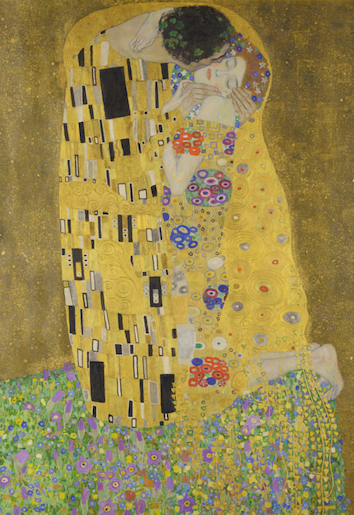
GUSTAV KLIMT’S “The Kiss,” speaks volumes to the emotion of love.
According to Marazziti and her colleagues, love can be organized into “attraction,” followed by building “romantic attachment.”
In the attraction step, the authors suggest that a brain structure called the amygdala, which is known for its involvement in regulating our fight-or-flight behavior, is activated in response to another person. This brain structure normally processes fear responses, but in the case of falling in love our brain codes the stimulus as positive rather than threatening. Therefore, the authors note that love can be understood as “a fear without fear.” The ensuing experience characterizes the altered state of being in love: raised energy, changes in appetite and sleep, lowering of rational judgment, and possible mood swings according to the reciprocation or not by the partner.
The authors go on to state that the following “romantic attachment” step involves the neuropeptide oxytocin (produced in the hypothalamus), which has been associated with many human behaviors: initiation and maintenance of pair bonding, infant attachment, and maternal behavior.
So, we’ve learned that the neurobiology of love can be understood through looking at different brain structures and biomarkers, but is it possible to “trick” the body into thinking it’s in love? If you asked a witch during the 17th century they’d probably say yes. And here’s how…
I recently read a paper published by Aldo Sena de Oliveira, PhD, and others, titled “Witches, potions, and metabolites: an overview from a medicinal perspective,” published in the Royal Society of Chemistry, and I thought it’d be fun to summarize the bit about “love potions.” But first, a very important disclaimer: literally do not try this at home! Some of these ingredients can be toxic and even fatal if ingested at the wrong dosage.
Now that that’s out of the way, let’s get on to the elixir of love that is commonly used in medieval tales. It includes a mix of ingredients that are meant to mimic the effects of love on the human body (shortness of breath, excessive sweating on the hands, difficulty in reasoning) such as mandrake root extract, henbane leaves, areca nut, and yellow hemp.
Mandrake roots are known to be potently narcotic and aphrodisiac. Henbane leaves are toxic and may cause hallucinations in moderate doses, but are used for their anesthetic properties as a tea. Areca nut can mimic the stimulating and euphoric effects of nicotine. And yellow hemp has a stimulating and broncho-dilating effect. I’m not sure I’m sold on the medieval love potion after reading about its effects, but, as always, if readers have any questions, please email me at: pcd1130@gmail.com.
Category: Entertainment