Burning questions: lessons learned from Cocoanut Grove fire
Windsor Square resident Dr. Leo A. Gordon gave a lecture at the home of his neighbor Janet Loveland last month on the devastating Cocoanut Grove fire of 1942. The lecture took place as part of the local chapter meeting of Daughters of the American Revolution. On Nov. 28, 1942, the popular Boston, Massachusetts, nightclub went up in flames, killing 490 people and injuring more than 200.
A surgeon and affiliate faculty member in Cedars-Sinai’s History of Medicine Program, Gordon regularly speaks about medical and societal advances attributable to lessons learned from historical events. He chronicled the events leading up to the horrific nightclub fire and the knowledge gained in its aftermath which felt relevant around the anniversary of the 2025 L.A. wildfires.
To set the scene, Gordon explained that in 1942 America had just come out of the Great Depression and was one year into World War II. Nov. 28, 1942, was during Thanksgiving weekend, and people wanted something to do. For many in Boston, that meant celebrating with dinner and dancing at the much sought-after two-story Cocoanut Grove nightclub. For them, the evening’s revelry ended in the seventh worst fire in U.S. history.
News coverage of the day recounted how just before the fire broke out a young man on a date was annoyed that a glaring light above his table was interfering with his amorous intentions, so he unscrewed the offending light bulb. When the maître d’ sent the 16-year-old busboy over to replace the bulb, he held a lit match up to the ceiling to better see where to put the bulb. Did the match flame start the fire? Again, the similarities to the January 2026 fire in Crans-Montana, Switzerland, strike a chord.
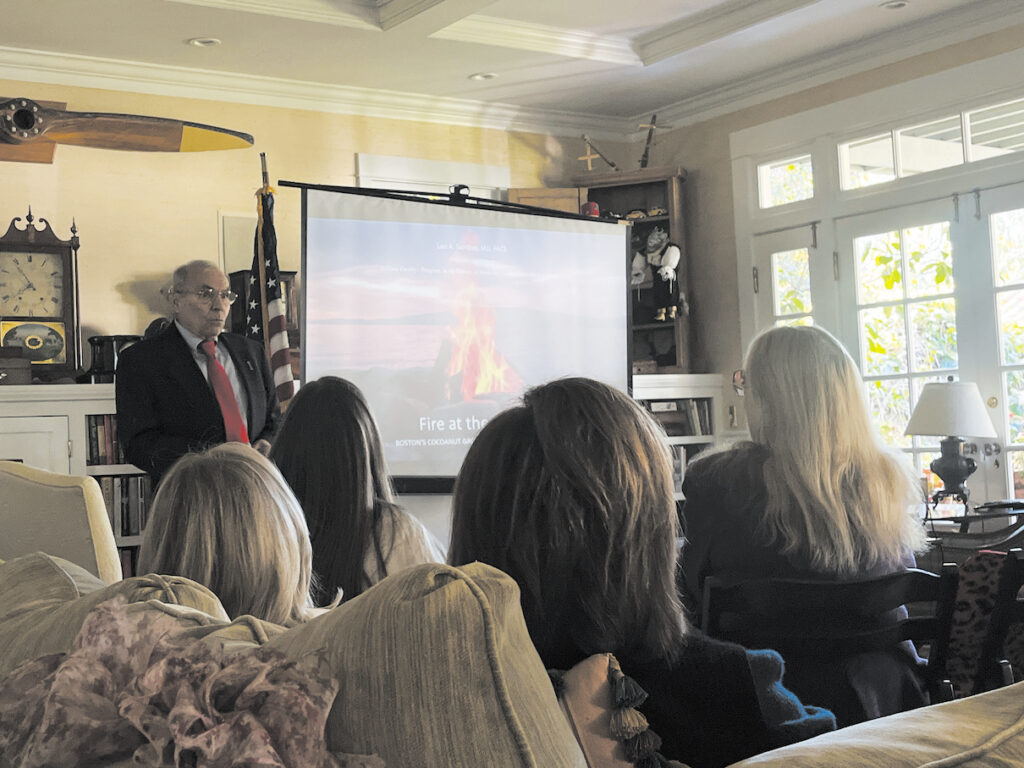
DR. GORDON, a surgeon and historian, gave a talk at a home in Windsor Square last month on a devastating 1942 Boston fire.
We know that the current and previous owners of the Cocoanut Grove were men of shady reputations. We know that corners were cut, and laws circumvented, for their financial benefit, including having the nightclub licensed as a restaurant, not a place of public gathering, thus avoiding the stricter rules for the latter, such as requiring sprinklers. The building itself and much of the wiring were in violation of building codes of the time. We know that the decorations did not comply with fire retardant regulations.
The Cocoanut Grove was approved for a capacity of 460; 1,000 crowded the place that night. When the fire broke out and quickly filled both floors of the building with smoke, panicked crowds found that the only path down from the second floor was by a narrow stairwell and one revolving door—the owner had arranged for every other exit door to be cemented shut or locked to keep guests from sneaking out without paying.
The Boston Fire Marshall, who dined there with his wife that night, had declared the nightclub safe only 10 days before.
Because there were numerous factors contributing to the severity of the fire and its toll, and an inconclusive investigation into the cause, the Fire Commissioner determined that “The fire will be entered into the record as of no known origin.”
As Gordon concluded, the real cause of the tragic fire was greed.
Among those who perished in the Cocoanut Grove fire were newlyweds who had just gotten married hours before; two women who were the first in Boston to join the WAVES, a branch of the U.S. Naval Reserve created that year to help the war effort by placing women in non-combat roles; the Boston College Eagles equipment manager and his wife; and Buck Jones, the most popular Western movie actor in the country. The Boston Fire Marshall and his wife both survived.
Information gleaned
Fire victims were rushed either to Boston City Hospital or Massachusetts General Hospital. Although there had been a citywide drill regarding burn care after Pearl Harbor, the two hospitals had vastly different approaches. BCH used tannic acid, which caused liver damage, and MGH treated the burns with petroleum jelly and gauze. Boston City switched to match MGH’s approach. Today, Mass General is recognized as a leading burn treatment center.
Gordon summarized the architectural changes spurred by an analysis of the devastation caused by the 23-minute fire. Well-marked exits are now required, maximum capacity signs must be posted, there are stricter rules for sprinklers, and staff must be trained in safety protocols. Another change: revolving doors often seen at the entrance to hotels and department stores must have separate swinging doors on either side for ease of egress. All of Boston’s building codes were revised.
Have we put into practice the lessons of the past?
Although our knowledge of fire safety is exponentially broader than it was in 1942, two things stand out from the recent New Year’s Eve fire at Le Constellation Bar in the ski resort town of Crans-Montana, Switzerland, which killed 40 people and seriously injured over 100: greed and incompetence often override safety.
Analysis to date indicates that the recent Swiss fire was caused by sparklers placed in champagne bottles and held aloft, lighting the highly flammable soundproofing on the ceiling, harkening back to the lit-match theory as the cause of the Cocoanut Grove fire. Just as there was only one way out of the Cocoanut Grove nightclub, most of those who perished in the Swiss fire were stuck in the venue’s narrow stairwell, the sole escape route since the only other exit, a service door, was locked. Additionally, the owner had renovated the bar in 2015, making the stairs dangerously narrow for panicked patrons hurrying to escape. And like the Boston Fire Marshall who looked the other way regarding code violations in the nightclub, Le Constellation Bar had not been inspected since 2019.
Blueprint for survival in L.A.
In L.A., Jan. 7th marked the one-year anniversary of the Palisades and Eaton wildfires, and there are still innumerable unresolved questions about whether decisions made in the heat of the moment contributed to the devastation. All told, over 16,000 structures were destroyed, and there were more than 30 fatalities, making them two of the five most destructive blazes in California history. Eighty square miles were burned.
Frontline workers acted heroically, without a doubt. But there were mistakes abound, some of them human errors that we must learn from.
The Palisades Fire was a rekindled fire—proper training in putting out wildfires early and successfully is key.
There is a question of whether enough fire engines were pre-deployed in the area and if the shift of fire workers should have been held over that were not.
A city-owned reservoir was offline for repair.
Mayor Karen Bass was out of the country on a diplomatic trip, and Altadena evacuations were late.
Ongoing analysis of the fire response and the cleanup efforts is critical to help us better prepare for the inevitable next time a conflagration threatens our communities.
California has been working on statewide regulations that focus on creating a zone of safety called a “Zone Zero,” a five-foot area around one’s home without greenery in wildfire-vulnerable areas—but their original deadline for developing a workable plan passed in Jan. 2023.
On Jan. 13 Los Angeles City Council decided not to wait for the state to act and resolved to create a plan for our city, but they are considering much less stringent fire safety measures, such as allowing well-maintained and healthy plantings, keeping trees trimmed 10 feet away from chimneys, but not the building itself, cleaning gutters, and disallowing wooden or combustible fences or sheds within five feet of homes. This has already caused a firestorm of concern that by trying to appease those who love trees and bushes close to their dwellings, they will be leaving communities vulnerable to the spread of fire.
Additionally, if California ever does pass statewide regulations, those rules will supersede whatever measures we implement locally.
There is also the law of unintended consequences. The Los Angeles Fire Department warns that severe restrictions on exterior property greenery could negatively affect the important urban tree canopy and diminish biodiversity.
Zone Zero will pertain to rural areas and urban communities that Cal Fire determined to be in “very high” fire hazard regions, which include much of Silverlake, Echo Park, Brentwood, and Pacific Palisades.
It is critical that our City Council and our state quickly implement a fire protection plan that can be adapted to the needs of our very different neighborhoods.
Category: People